
Modelled thermal performance and sustained processor power of the fanless Thinvent PPC15 15-inch industrial panel PC
Will the fanless PPC15 run on your shop floor?
- The PPC15 takes 15 W processors only and stands with its screen upright in still air. It runs at its 15 W continuous base power all day without slowing down up to 50 °C.
- The processor reaches its 100 °C limit at 42 W at 25 °C and 36 W at 35 °C. It reaches 100 °C at 31 W at 45 °C and 28 W at 50 °C.
- At 15 W on 25, 35 and 45 °C shop floors, the front screen and bezel reach about 32, 41 and 51 °C.
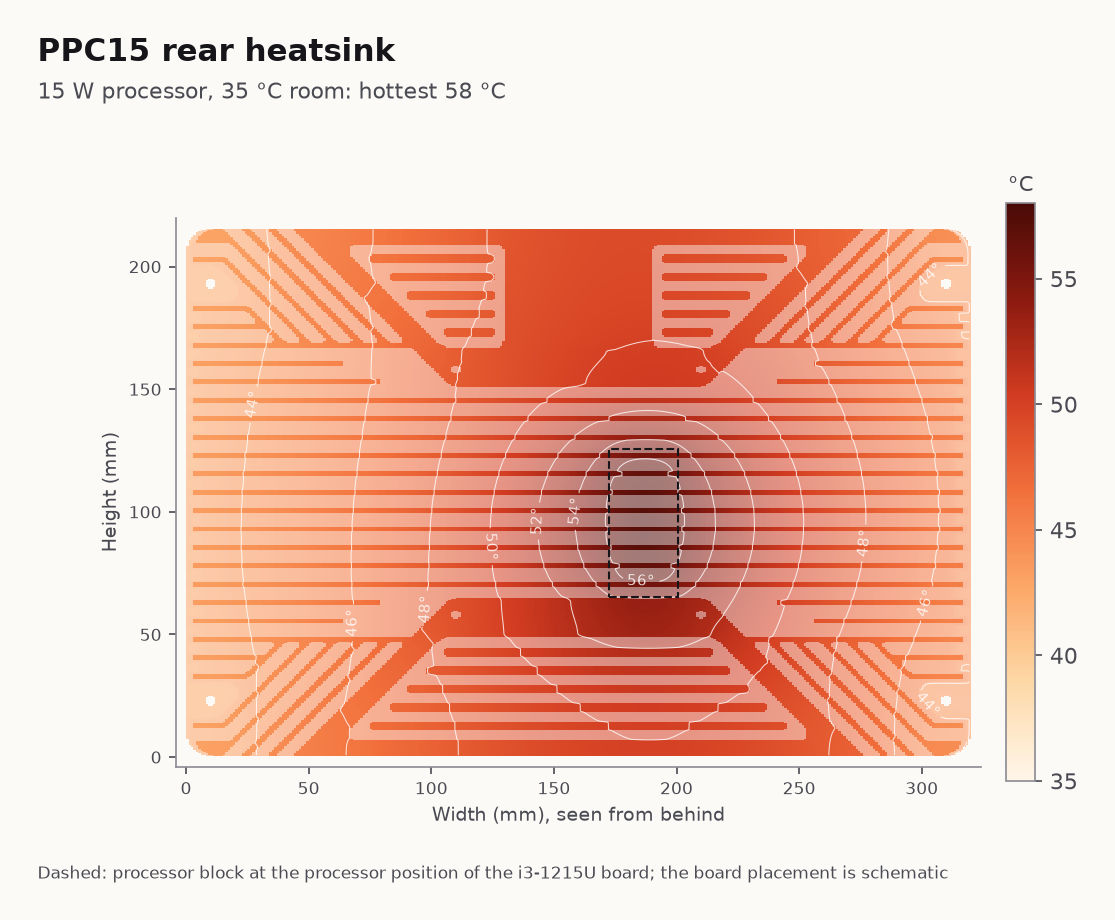
- On those shop floors, the finned rear heatsink hottest point reaches about 48, 58 and 67 °C. The average rear surface reaches 38, 47 and 57 °C.
- At 15 W on 25, 35 and 45 °C shop floors, the processor runs at 56, 65 and 75 °C. All three temperatures stay well below the 100 °C processor limit.
- The processor boosts to its 55 to 57 W maximum turbo power for short bursts. A short burst at 35 °C peaks near 69 °C before settling to 65 °C at 15 W.
- If a continuous load needs 55 W, the processor reaches its 100 °C limit. The processor then lowers its power consumption (throttling) to stay at 100 °C.
- In a panel cut-out or enclosure wall, the finned back is inside the cabinet while the screen faces out. Cabinet air temperature is the temperature that matters for the back.
- Leave clear space for air to rise past the rear fins. Ventilate the cabinet so trapped heat does not push air behind the computer past your target temperature.
Sustained processor power across shop-floor temperatures

- Shipped Intel Core i3-1215U: 15 W base rating and 12 W minimum assured rating. Its 55 to 57 W maximum turbo rating is for short bursts only.
- Shipped Intel Core Ultra 5 125U: 15 W base rating and 12 W minimum assured rating. Its 55 to 57 W maximum turbo rating is for short bursts only.
- Listed Intel Core i3-1315U option: 15 W base rating and 12 W minimum assured rating. Its 55 to 57 W maximum turbo rating is for short bursts only.
- Listed Intel Core i5-1335U option: 15 W base rating and 12 W minimum assured rating. Its 55 to 57 W maximum turbo rating is for short bursts only.
- Listed Intel Core i7-1255U option: 15 W base rating and 12 W minimum assured rating. Its 55 to 57 W maximum turbo rating is for short bursts only.
- Listed Intel Core 5 120U option: 15 W base rating and 12 W minimum assured rating. Its 55 to 57 W maximum turbo rating is for short bursts only.
- Listed Intel N5095A option: 15 W base rating and 12 W minimum assured rating. Its 55 to 57 W maximum turbo rating is for short bursts only.
- Listed AMD Ryzen 5 7430U option: 15 W base rating and 12 W minimum assured rating. Its 55 to 57 W maximum turbo rating is for short bursts only.
- Listed AMD Ryzen 5 7530U option: 15 W base rating and 12 W minimum assured rating. Its 55 to 57 W maximum turbo rating is for short bursts only.
Rear heatsink and front screen temperatures by processor power and shop-floor temperature

Whole rear heatsink temperature at base power
Rear heatsink, front screen and processor temperatures against processor power

Ninety-minute response from idle to a maximum turbo burst and 15 W base load

Effect of display heat on processor, rear heatsink and front screen temperatures
