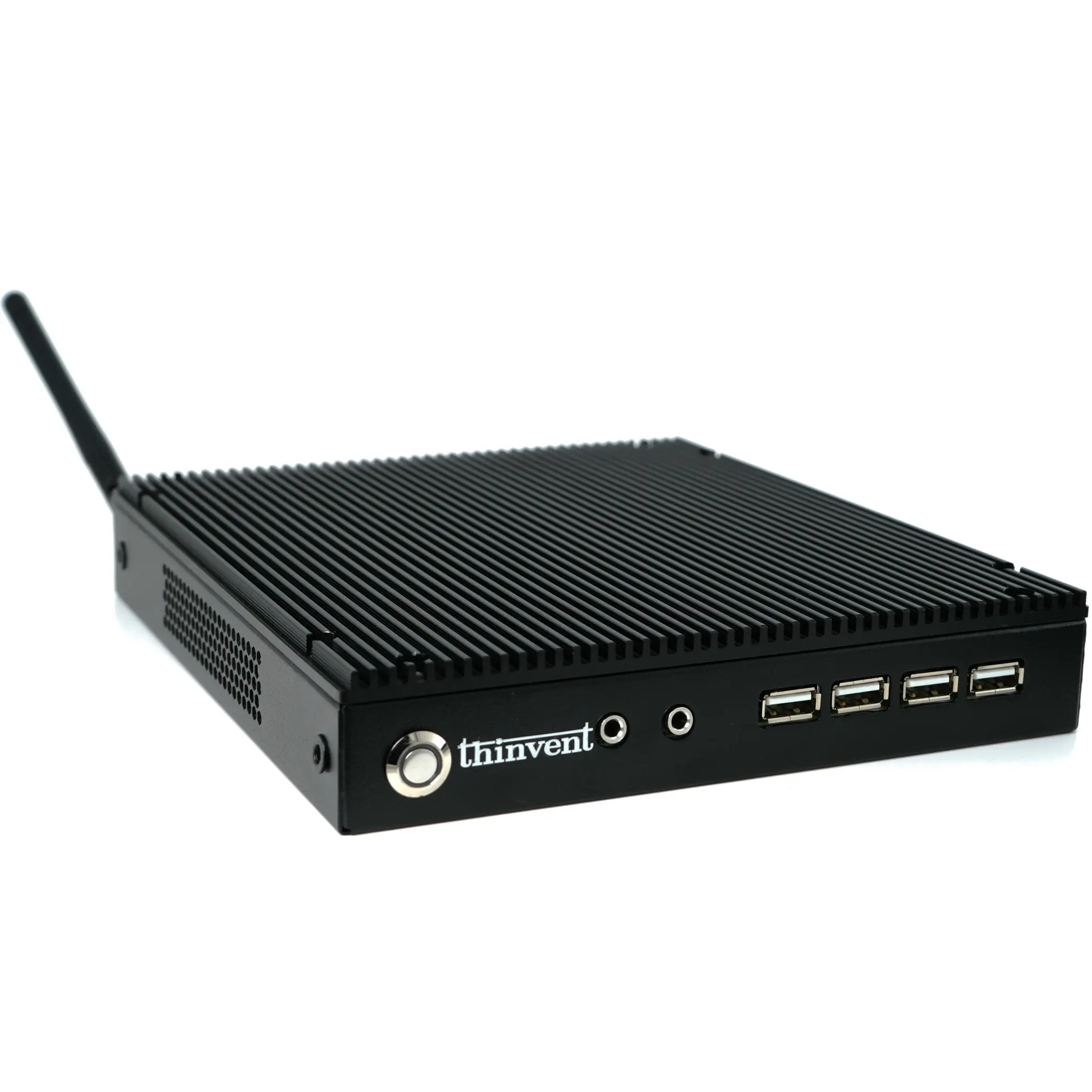
The Beckhoff Industrial PC is a box-style industrial PC series for control cabinet and machine automation. Beckhoff describes its IPCs as compact, sturdy and configurable, with single-core to many-core options and a range of processors, interfaces and protection classes. For a closely matched alternative, Thinvent's IPC1, IPC3 and IPC5 industrial PC lines offer Intel and AMD processors with configurable RAM and SSD storage for industrial applications.
Beckhoff Industrial PC vs Thinvent Industrial PCs
| Beckhoff C6030-0050 (Industrial PC) | Thinvent Industrial PC IPC5, Intel Core i5-1235U | Thinvent Industrial PC IPC1, AMD Ryzen 5 7530U | |
|---|---|---|---|
| Processor | Not stated | Intel Core i5-1235U | AMD Ryzen 5 7530U |
| Cores/Threads | Not stated | 10 cores | 6 cores |
| RAM | 8 GB DDR4 | 4 GB to 64 GB | 4 GB to 64 GB |
| Storage | 40 GB M.2 SSD | 128 GB to 2 TB SSD | 128 GB to 2 TB SSD |
| Form Factor | Compact box PC, 132 x 133 x 76 mm | Industrial PC | Industrial PC |
| Connectivity | Two 2.5GbE ports, four USB 3.2 Gen 2 ports | Not stated | Not stated |
Key differences
-
Thinvent IPC5 with Intel Core i5-1235U offers up to 64 GB RAM and up to 2 TB SSD, against the 8 GB RAM and 40 GB SSD stated for the Beckhoff C6030-0050.
-
Thinvent IPC1 with AMD Ryzen 5 7530U also offers up to 64 GB RAM and up to 2 TB SSD, with a choice of Wi-Fi 5 dual-band or no wireless.
-
Thinvent IPC5 and IPC1 lines list 10 and 6 cores respectively, so buyers needing a specific core count can compare them directly.
-
The Beckhoff C6030-0050 lists two 2.5GbE ports and four USB 3.2 Gen 2 ports, and its compact 132 x 133 x 76 mm dimensions are stated. Thinvent's connectivity details are not listed in the product specifications provided here.
-
Beckhoff offers a very broad range of customer-specific builds, including logos, labels and custom functions, which Thinvent's listed configurations do not describe.
Which one should you choose?
Choose the Beckhoff Industrial PC if you need its stated 2.5GbE and USB 3.2 Gen 2 connectivity in a compact box design, or if you want its wide customer-specific build options. Choose a Thinvent Industrial PC if you need more RAM and storage headroom, with up to 64 GB RAM and 2 TB SSD, and a choice of Intel or AMD processors.