What Makes a Good CPU for Industrial Applications?
A good CPU for industrial computing is defined by its reliability, performance-per-watt, thermal efficiency, and long-term availability. Unlike consumer-grade processors, industrial CPUs must operate flawlessly in harsh environments with wide temperature ranges, constant vibration, and 24/7 uptime requirements. Key specifications to evaluate include core count, clock speed, thermal design power (TDP), integrated graphics capabilities, and support for industrial I/O interfaces.
Key Specifications and Technical Details
Modern industrial CPUs balance processing power with energy efficiency. Important metrics include:
-
Core Count & Threads: Multi-core processors (e.g., 4, 6, 10 cores) handle multitasking and parallel processing for machine vision, data acquisition, and control systems.
-
Clock Speed & Turbo Boost: Base frequency ensures stable operation, while turbo boost provides bursts of speed for demanding computational tasks.
-
Cache Memory: Larger cache (e.g., 6MB, 12MB) significantly improves performance by reducing the time needed to access frequently used data.
-
Integrated Graphics: Modern Intel processors feature capable integrated GPUs (Intel® UHD Graphics, Iris® Xe) for driving multiple displays in digital signage or handling light graphical workloads.
-
Fanless Design: A critical feature for industrial PCs, achieved through low-TDP processors (often 9W to 28W) and intelligent chassis design, eliminating moving parts that can fail due to dust or vibration.
Use Cases and Applications
The right CPU powers diverse industrial solutions:
-
Digital Signage & Kiosks: Requires reliable, fanless operation and capable integrated graphics for smooth multimedia playback.
-
Factory Automation & PLCs: Demands deterministic performance and support for real-time operating systems (RTOS) to control machinery.
-
Thin Clients & VDI: Efficient, low-power CPUs are ideal for accessing virtualized desktop environments in offices and call centers.
-
Edge Computing & IoT Gateways: Processes data locally at the network edge, requiring a balance of compute performance, I/O connectivity, and power efficiency.
-
Transportation & In-Vehicle Systems: Must withstand extreme temperatures and shocks, making rugged, fanless designs with soldered components essential.
CPU Comparison for Common Industrial Tasks
| Application | Recommended CPU Series | Key Priorities | Typical Core Count |
|---|---|---|---|
| Basic HMI, Thin Client | Intel® Celeron, Intel® Processor N Series | Power Efficiency, Cost, Fanless | 4 |
| Digital Signage, Kiosk | Intel® Core i3, Intel® Processor N Series | Integrated Graphics, Reliability | 4-6 |
| Edge Gateway, Data Acquisition | Intel® Core i5, Intel® Core i3 | I/O Connectivity, Sustained Performance | 6-10 |
| Machine Vision, Light AI | Intel® Core i5, Intel® Core i7 | CPU/GPU Performance, High Cache | 10-12+ |
Thinvent Industrial Computers with Optimized CPUs
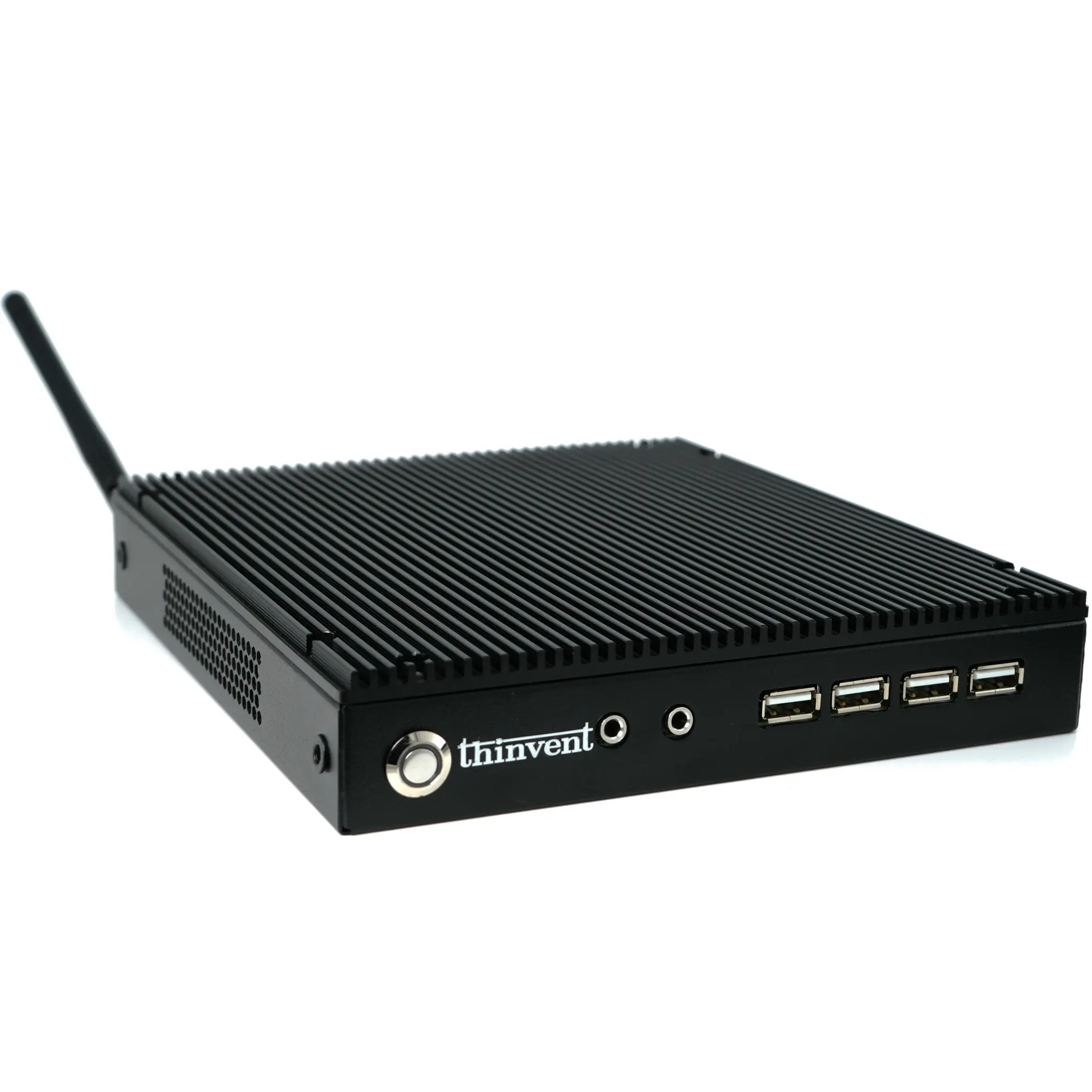
Thinvent designs a comprehensive range of industrial computing solutions built around the right CPU for the job. Our product lines include compact Mini PCs and Thin Clients powered by efficient Intel N-series and Celeron processors for space-constrained, fanless applications. For more demanding tasks, our Industrial PCs and All-in-One panels feature higher-performance Intel Core i3, i5, and i7 processors from the latest generations. Every system is engineered for durability, featuring wide-temperature operation, robust connectivity options, and long-term component supply, ensuring your investment is protected for the lifecycle of your deployment.