What "Cheapest CPU" Really Means for a Computer Buyer
When people search for the cheapest CPU, they are usually not shopping for a bare processor chip — they are looking for the most affordable complete computer that still does the job. The cost of a finished mini PC, thin client, or industrial PC is driven by the processor class, memory, storage, and cooling design, not by the chip alone. Entry-level Intel processors such as the Celeron and N-series (for example the Intel N100, N150, and J4125) are built for exactly this purpose: everyday computing at the lowest possible system cost.
The key technical point is that these low-cost processors are not slow in any meaningful sense for office and control-room work. A modern 4-core Intel N100 or N150 can drive dual displays, handle spreadsheets, browsing, point-of-sale software, and remote desktop sessions comfortably. They also draw very little power, which means they can be cooled without a fan — a major reliability advantage in dusty or hot environments.
Matching the Processor to the Workload
| Processor Class | Typical Cores | Best Suited For | Power Draw |
|---|---|---|---|
| Intel Celeron / J4125 | 4 | Basic kiosks, signage, data entry | Very low |
| Intel N100 / N150 | 4 | Office PCs, thin clients, POS, digital signage | Very low |
| Intel Core i3 (e.g. 1215U) | 6 | Multitasking, industrial control, light virtualization | Low |
| Intel Core i5 | 10-12 | Demanding industrial and workstation tasks | Moderate |
The rule of thumb is simple: buy the smallest processor that comfortably covers your software. Paying for an i5 to run a browser-based dashboard wastes money; running a heavy database on a Celeron will frustrate users. For most cost-sensitive deployments — schools, retail counters, factory HMIs, and call centres — a 4-core N-series or Celeron platform delivers the best cost-per-seat.
Why Fanless Design Lowers Total Cost
A fanless computer removes the single most common failure point in a PC: the cooling fan. No fan means no dust ingress, no bearing wear, and no filter maintenance. In practice this extends service life and cuts downtime, which is where the real savings appear. A slightly higher purchase price on a fanless unit is usually recovered within a year through reduced maintenance and fewer replacements.
Use Cases for Low-Cost Computing
Entry-level processors power a surprising share of the world's computing: retail point-of-sale terminals, hospital data-entry stations, airport and mall digital signage, thin-client desks in banks, machine HMIs on factory floors, and student lab machines. In every one of these roles, reliability and low power matter more than raw benchmark scores.
Thinvent's Range for Cost-Sensitive Deployments
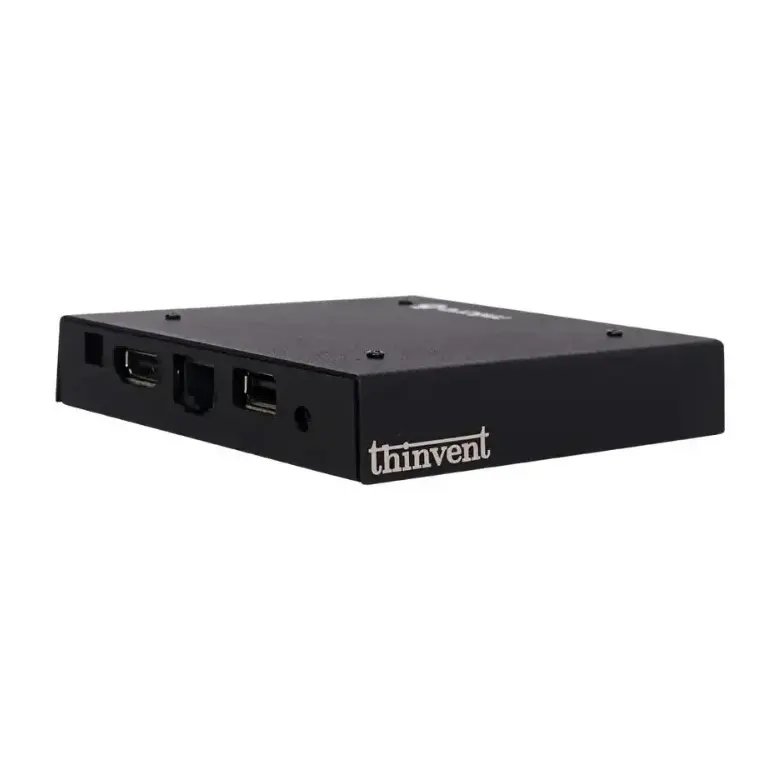
Thinvent builds a full range of fanless mini PCs, thin clients, industrial PCs, and all-in-one computers around entry-level and mid-range Intel processors. Buyers who need the lowest system cost can choose Celeron and N-series models, while those who need more headroom can step up to Intel Core i3 platforms such as the 1215U with 6 cores, up to 4.4 GHz, and 10 MB cache. Every unit is available with Windows 11 Pro, Ubuntu Linux, or without an operating system, and can be configured with 4 GB to 64 GB memory and 128 GB to 1 TB SSD storage to match your budget exactly.