The Ideal Computer for Architectural Workflows
Architects require powerful, reliable computing systems to handle demanding software like AutoCAD, Revit, SketchUp, and rendering engines. The ideal computer for an architect balances high-performance multi-core CPUs for complex calculations and 3D modeling, ample RAM for multitasking with large project files, and fast SSD storage for quick data access and application loading. Dedicated graphics processing is also a key consideration for smooth viewport navigation and rendering acceleration, though many modern integrated GPUs in high-performance processors are now capable for mainstream architectural tasks.
Key Specifications for Architectural Computing
When selecting a computer for architecture, focus on these core components:
-
Processor (CPU): Modern multi-core Intel Core i5 or i7 processors (12th generation or newer) are recommended. High core and thread counts significantly improve performance in rendering and simulation tasks.
-
Memory (RAM): 16GB is the absolute minimum for professional work; 32GB or more is ideal for handling large, complex BIM models and multitasking.
-
Storage: A fast NVMe SSD (512GB or larger) is essential for operating system, application, and project file speed. Many workstations benefit from a secondary SSD or HDD for archiving completed projects.
-
Graphics: While a dedicated GPU (from NVIDIA or AMD) offers the best performance for 3D visualization and rendering, modern Intel Core processors with integrated Iris Xe graphics provide capable performance for core modeling and drafting applications.
-
Reliability & Cooling: Fanless or robustly cooled industrial-grade PCs ensure silent operation and long-term reliability in studio environments, preventing thermal throttling during sustained workloads.
Applications and Use Cases
Architectural computers are deployed across the entire design and construction lifecycle:
-
Design & Drafting: Running 2D CAD and 3D BIM software for creating plans, sections, and detailed models.
-
Visualization & Rendering: Generating photorealistic still images, animations, and virtual walkthroughs for client presentations.
-
Project Management & Collaboration: Handling large PDF sets, specification documents, and cloud-based collaboration platforms.
-
Construction Documentation: Producing detailed drawing sets and coordinating with structural and MEP models.
Thinvent Solutions for Architectural Professionals
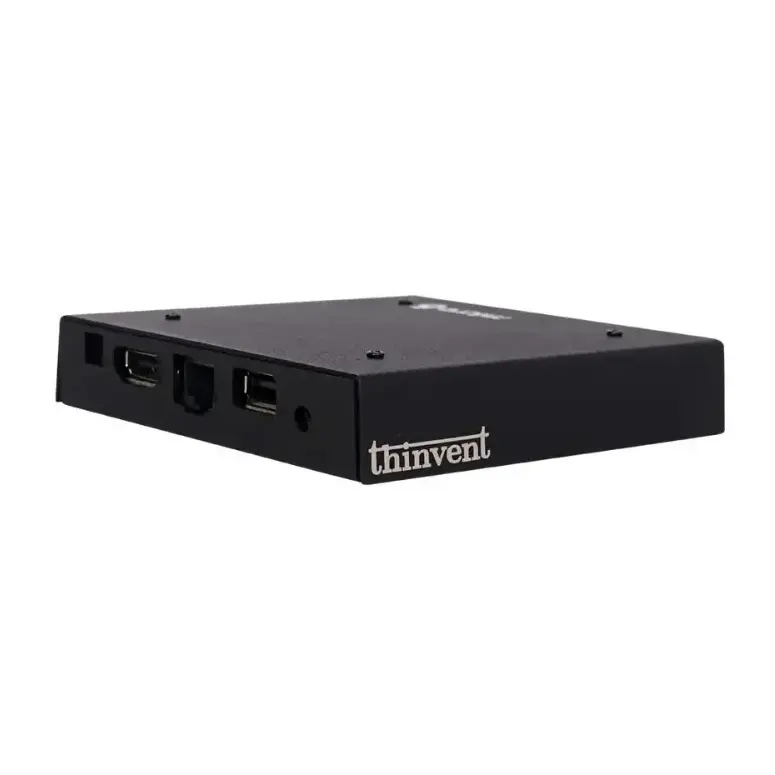
Thinvent offers a range of industrial-grade computing solutions built to meet the rigorous demands of architectural practice. Our compact and fanless designs provide the silent, reliable performance required for focused design work.
For Core Design & Drafting: Our systems powered by Intel Core i3 and i5 processors (like the i3-1215U and i5-1250P) offer an excellent balance of performance and efficiency. Paired with 8GB to 16GB of RAM and fast SSD storage, they deliver smooth operation in AutoCAD, Revit, and SketchUp.
For High-Performance Workstations: For more demanding tasks involving large models, complex simulations, or GPU-accelerated rendering, our platforms supporting high-core-count Intel processors (like the 14th Gen Core 5 120U) provide the necessary computational power. Configured with 16GB+ of RAM and large-capacity SSDs, these systems are built for productivity.
All Thinvent industrial PCs and mini PCs are engineered for 24/7 reliability in controlled environments, featuring robust construction and efficient thermal management to ensure consistent performance throughout the longest design sessions.