What CPU is Best for Architectural Rendering?
For architectural rendering, the ideal CPU is a high-performance, multi-core processor that excels at parallel processing. Rendering complex 3D models and generating photorealistic images is a computationally intensive task that benefits greatly from a high core and thread count. While a powerful dedicated GPU is also crucial, the CPU handles the core logic, scene preparation, and certain rendering engines (like CPU-based ones) entirely. Key specifications to prioritize include a high number of cores (12+), high clock speeds, large cache sizes, and support for modern instruction sets.
Key Specifications and Technical Details
The primary goal is to reduce render times. This is achieved through:
-
High Core/Thread Count: Rendering software like V-Ray, Corona, and Blender Cycles can distribute workloads across all available CPU cores and threads. More cores directly translate to faster render completion.
-
High Clock Speeds: While multi-threading is key, single-core performance (governed by clock speed) is still important for tasks within the 3D application's viewport and for certain pre-render calculations.
-
Large Cache: A large L3 cache (e.g., 24MB+) allows the CPU to store more data close to the cores, speeding up access to the complex scene data during rendering.
-
Memory Support: The CPU must support sufficient RAM capacity (64GB+) and high-speed memory to feed data to the cores without bottlenecking.
Use Cases and Applications
These CPUs are essential for professionals using:
-
3D Modeling & Visualization Software: Autodesk 3ds Max, Maya, SketchUp, Rhino, Blender.
-
Rendering Engines: V-Ray (CPU & GPU modes), Corona Renderer, Arnold, Enscape, Lumion (which also heavily leverages GPU).
-
BIM Software: Rendering detailed models from Revit, ArchiCAD, and Vectorworks.
-
Post-Production: Compositing high-resolution render passes in Adobe After Effects or DaVinci Resolve.
CPU Comparison for Rendering Workloads
| Feature | Entry-Level / Draft Rendering | Professional / Production Rendering | High-End / Studio Rendering |
|---|---|---|---|
| Core Count | 6-10 Cores | 12-16 Cores | 18+ Cores / 24+ Threads |
| Series | Intel Core i5 / i7 | Intel Core i7 / i9 | Intel Core i9 / Xeon |
| Typical Gen | 12th / 13th Gen | 13th / 14th Gen | Latest Gen / Workstation Class |
| Recommended RAM | 32 GB | 64 GB | 128 GB+ |
| Use Case | Small projects, client previews | Full architectural visualizations, animations | Complex scenes, 4K/8K animation, batch rendering |
Thinvent Industrial PCs for Architectural Rendering
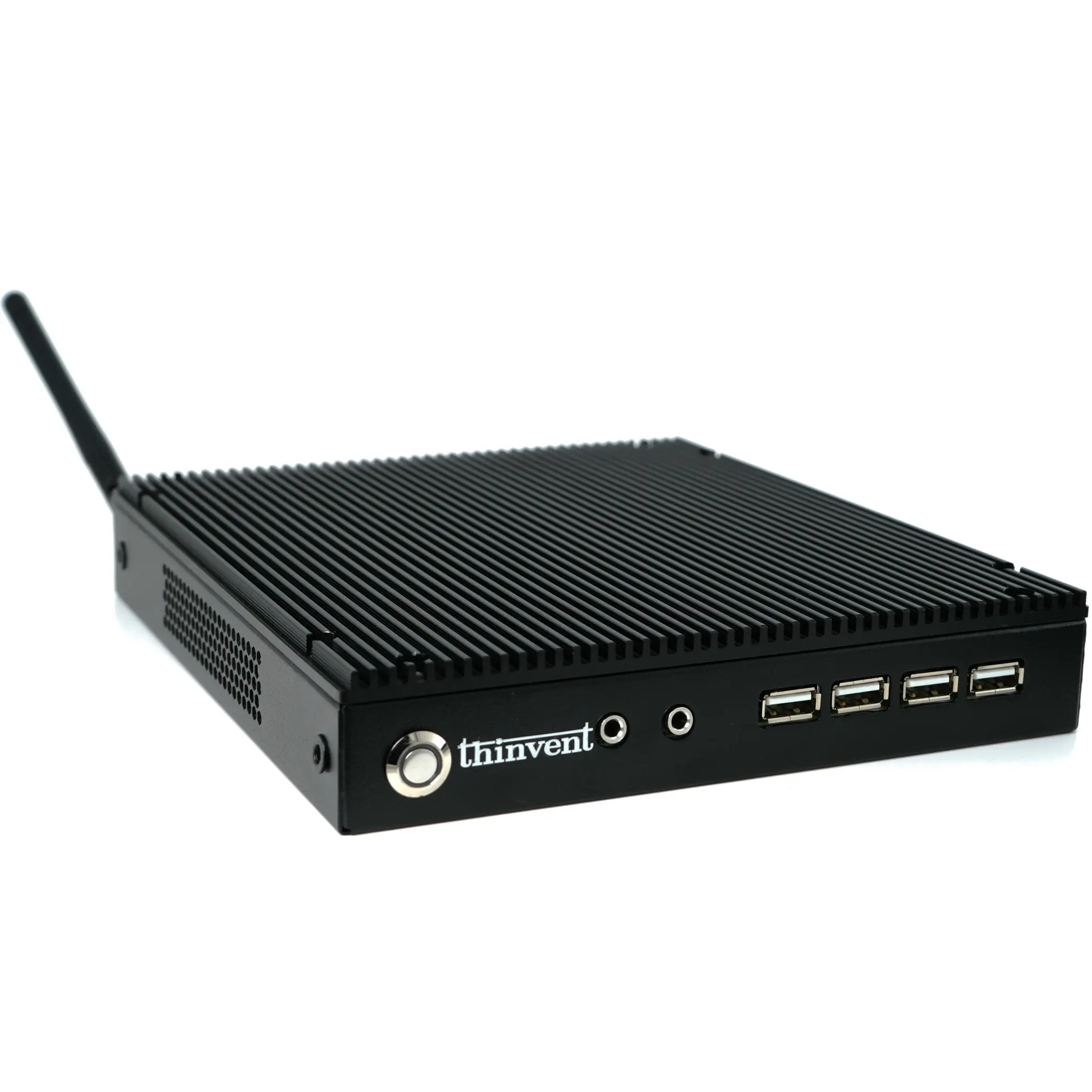
Thinvent offers a range of robust industrial computing solutions engineered for demanding workloads like architectural rendering. Our systems are built with reliability and sustained performance in mind, featuring efficient cooling to handle continuous high CPU loads during overnight renders. We provide configurations with the latest high-core-count Intel processors, ample high-speed DDR4/DDR5 RAM, and fast NVMe SSD storage to minimize project load and save times. Whether you need a compact yet powerful workstation for a design studio or a rack-mounted render node for a server farm, Thinvent's fanless and rugged designs ensure stable operation in various professional environments.