What Makes a CPU Efficient for a Home Server?
An efficient CPU for a home server balances performance with low power consumption, thermal output, and cost. The primary goal is reliable, 24/7 operation for tasks like media serving, file storage, network management, and light virtualization without excessive energy bills or heat. Key characteristics include a modern architecture for better performance-per-watt, integrated graphics to save on a discrete GPU, and support for essential server features like virtualization (VT-x) and AES-NI for encryption.
Recommended CPU Specifications
For most home server applications, a quad-core or hexa-core processor from a recent generation is ideal. Intel's N-series (like the N100) and U-series Core processors (i3, i5) are excellent choices, offering a blend of efficiency and capability. ARM-based processors are also highly efficient for lightweight, dedicated tasks like network firewalls or simple file servers. Look for CPUs with a Thermal Design Power (TDP) in the 6W to 28W range. Sufficient RAM (8GB minimum, 16GB+ for virtualization) and fast, reliable SSD storage are equally critical to prevent bottlenecks.
Ideal Home Server Use Cases
-
Media Server (Plex/Jellyfin): Requires a CPU with strong single-thread performance and Quick Sync video transcoding (Intel) for efficient media playback on various devices.
-
Network-Attached Storage (NAS): Efficiency and core count for handling file transfers and running services like Docker containers for *arr apps, VPNs, and backup tools.
-
Home Automation & IoT Hub: A low-power CPU is perfect for running platforms like Home Assistant, where constant uptime is more critical than raw compute power.
-
Light Virtualization/Development Server: Running a few Linux VMs or containers for web development, testing, or self-hosted applications benefits from multiple cores and support for virtualization technology.
CPU Comparison for Home Servers
| Feature | Intel N-Series (e.g., N100) | Intel U-Series (e.g., i3-1215U) | ARM (e.g., Cortex A55) |
|---|---|---|---|
| Best For | Lightweight NAS, Firewall, Low-Power Media Serving | Versatile NAS, Media Server, Light Virtualization | Ultra-Low Power, Dedicated Appliance (DNS, Pi-hole) |
| Power Efficiency | Excellent (6W TDP) | Very Good (15-28W TDP) | Outstanding (Sub-10W) |
| Performance | Good for basic tasks | Strong for multi-threaded workloads | Sufficient for specific, optimized tasks |
| Transcoding | Hardware via Quick Sync | Hardware via Quick Sync | Software-only (limited) |
| Expandability | Limited I/O | Good I/O (USB, PCIe lanes) | Very Limited I/O |
Thinvent Solutions for Your Home Server
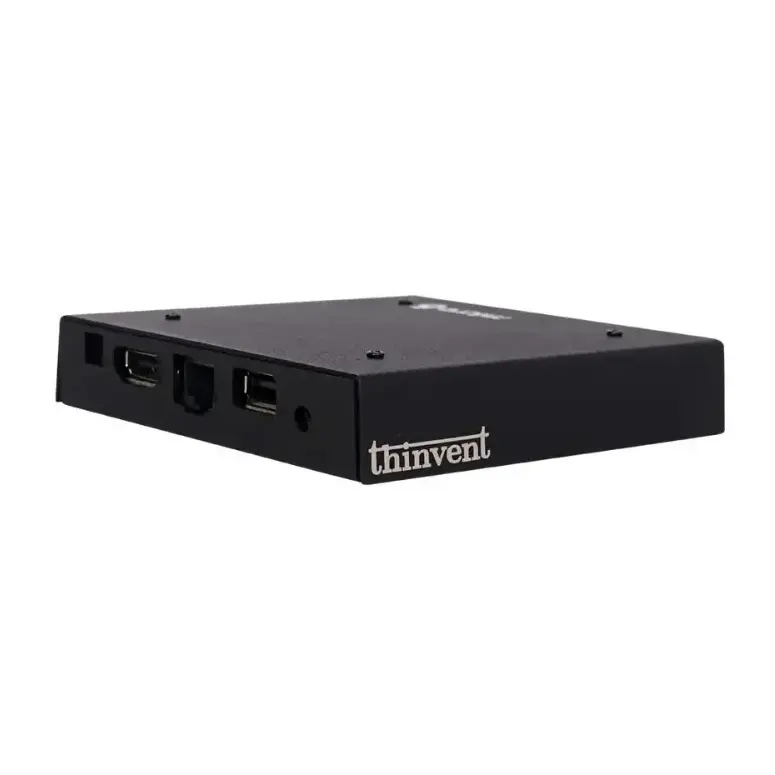
Thinvent offers a range of compact, reliable systems powered by efficient CPUs perfect for home server setups. Our fanless and low-noise designs ensure silent 24/7 operation.
-
For Maximum Efficiency & Basic Tasks: The Thinvent Treo and IPC1 Mini PCs feature the Intel Processor N100. With 4 efficient cores and a 6W TDP, they are ideal for a lightweight NAS, network gateway, or docker host, offering excellent performance per watt.
-
For Balanced Performance: The Thinvent Aero and IPC3 models equipped with Intel Core i3-1215U processors provide 6 cores and higher turbo speeds. This extra power handles Plex transcoding, multiple Docker containers, and light virtualization with ease.
-
For Advanced Workloads: The Thinvent Aero with Intel Core 5 120U or Industrial PC IPC5 with i5-1250P deliver 10 and 12 cores respectively. These are suited for demanding home labs, serving as a powerful virtualization host or a busy multi-user media server.
All Thinvent systems are built for durability and stable operation, making them a trustworthy foundation for your self-hosted services.