What Is a Data Acquisition (DAQ) Computer?
A data acquisition computer is a computing platform purpose-built to collect, condition and process signals from the physical world — sensors, transducers, meters, PLCs, machines and test rigs — and turn them into usable digital data. Unlike an office desktop, a DAQ system must run continuously on a factory floor or in a test cell, tolerate dust, vibration and wide temperature swings, and offer the legacy and industrial I/O that instruments actually speak: RS-232/RS-485 serial, digital I/O, and often dual Ethernet for segregated control and plant networks.
The practical requirements of a data acquisition PC come down to four things: reliable I/O, deterministic and stable operation, adequate processing headroom for logging and analytics, and fanless, maintenance-free cooling so there are no moving parts to clog with dust. Serial connectivity is usually the single most important interface, because a large installed base of instruments, weighbridges, energy meters, barcode readers, CNC controllers and legacy PLCs still communicate over RS-232 or RS-485.
Key Specifications to Look For
| Requirement | Typical Specification | Why It Matters for Data Acquisition |
|---|---|---|
| Processor | Intel® Core™ i3 / i5, 10th–14th gen, 4–10 cores | Handles multi-channel polling, buffering and local analytics |
| Memory | 8–32 GB DDR4/DDR5 | Keeps large ring buffers and databases in RAM |
| Storage | 256 GB – 1 TB SSD | Fast, shock-resistant logging and retention |
| Serial ports | Multiple RS-232/RS-485 (DB9) | Direct connection to instruments and legacy devices |
| Ethernet | 1–2 × Gigabit | Separates control network from plant/IT network |
| Cooling | Fanless, wide-temperature design | No dust ingress, no fan failure, silent operation |
| Power | 12 V DC or wide-range DC input | Works with industrial power supplies and battery backup |
| Mounting | DIN-rail, wall or VESA | Fits inside panels and cabinets |
Operating System and Software Considerations
Data acquisition workloads usually favour a stable, long-support OS. Windows 11 Pro and Windows 11 IoT Value editions are common where SCADA, HMI and vendor instrument software must run natively. For headless loggers, gateways and edge analytics, Linux — including embedded distributions — offers a smaller footprint, scriptable drivers, and the ability to run unattended for years without licence overhead. Some integrators prefer a system shipped without an OS so they can deploy their own image and control the full software stack.
Typical Applications
-
Machine and process monitoring — polling PLCs, VFDs and sensors over Modbus RTU/TCP
-
Test and measurement benches — capturing data from instruments, load cells and DAQs
-
Energy and utility monitoring — reading meters and power quality analysers over RS-485
-
Weighbridge and barcode stations — serial scales and scanners feeding a local database
-
Edge gateways — buffering and forwarding plant data to cloud or MES/ERP systems
-
Laboratory and research setups — long-duration unattended logging
Thinvent Products for Data Acquisition
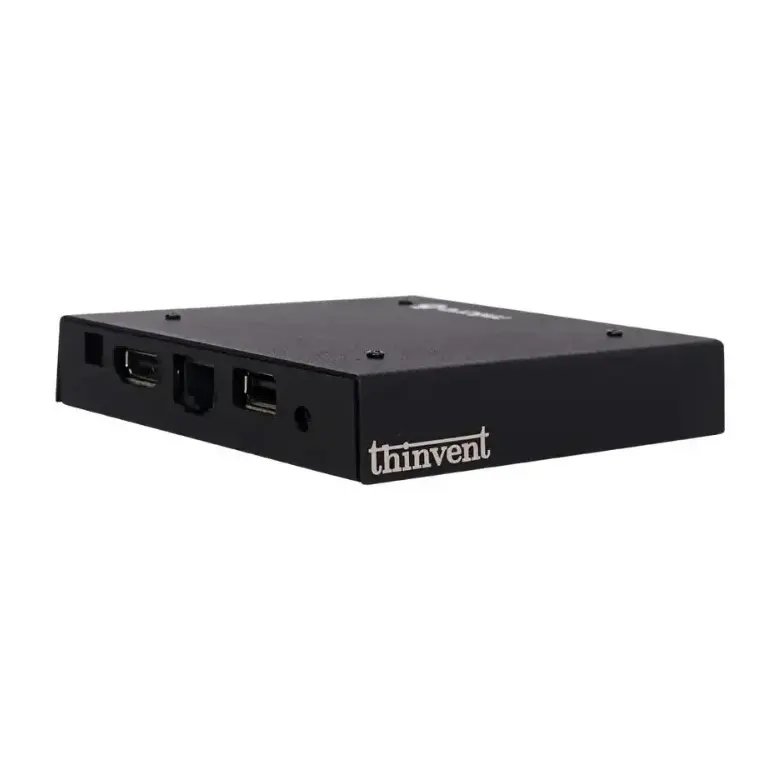
Thinvent builds fanless industrial computers and mini PCs designed for exactly this class of work. The IPC3 industrial PC pairs an Intel® Core™ i3-1215U processor (6 cores, up to 4.4 GHz, 10 MB cache) with up to 16 GB DDR4 RAM and 1 TB SSD, and is available in configurations with quad DB9 serial ports for direct multi-instrument connectivity. Thinvent systems can be ordered with Windows 11 Professional, Windows 11 IoT Value, an embedded Linux build, DOS, or without an operating system, so you can match the platform to your SCADA, HMI or custom logging application. With no fans, wide DC input options and industrial mounting, they are built to sit near the machines and keep collecting data, day after day.