Understanding the Dell Pro Tower Qct1250 Datasheet
The Dell Pro Tower Qct1250 is a professional-grade desktop computer designed for business and industrial environments. While specific datasheet details for this model may vary, such systems typically feature robust Intel Core i5 or i7 processors from the 12th or 13th generation, offering a balance of performance and efficiency for demanding workloads. Key specifications often include support for substantial DDR4 or DDR5 memory (32GB or more), multiple storage options (NVMe SSDs and HDDs), and a range of connectivity ports including USB 3.2, HDMI, and DisplayPort. These towers are engineered for reliability in 24/7 operations, with features like tool-less chassis design for easy maintenance and advanced thermal management.
Key Specifications and Technical Details
A typical datasheet for a professional tower like the Qct1250 would highlight core technical components. The processor is central, often an Intel Core i5-12500 or similar, featuring a hybrid architecture with Performance and Efficient cores. Memory support is crucial, with these systems commonly supporting up to 128GB of dual-channel RAM. For storage, they offer multiple bays for 2.5" and 3.5" drives alongside M.2 slots for high-speed NVMe storage. Expansion is a key strength, with multiple PCIe slots (x16, x4, x1) for adding graphics cards, network cards, or other peripherals. Standard I/O includes numerous USB ports (Type-A and Type-C), audio jacks, and integrated Intel UHD Graphics.
Use Cases and Applications
The Dell Pro Tower Qct1250 is suited for a variety of professional applications. Its power and expandability make it ideal for CAD/CAM workstations, software development environments, and media editing stations. In corporate settings, it serves as a reliable departmental server or a high-performance workstation for financial modeling. Its robust build also allows it to function in light industrial roles, such as controlling digital signage networks, acting as a host for virtualization, or running database applications. The tool-less design facilitates easy upgrades and maintenance, ensuring long-term viability in evolving IT infrastructures.
Comparison: Tower vs. Compact Industrial PCs
While traditional towers offer maximum expandability, modern industrial computing often leverages compact, fanless designs for different advantages.
| Feature | Professional Tower (e.g., Qct1250) | Industrial Fanless Mini PC |
|---|---|---|
| Form Factor | Large, vertical tower | Ultra-compact, wall/DIN-rail mountable |
| Cooling | Active (fans) | Passive (fanless) |
| Expandability | High (multiple PCIe slots, drive bays) | Moderate (M.2, limited I/O expansion) |
| Durability | Standard office/DC environment | Wide temperature, shock/vibration resistant |
| Power Consumption | Higher (150W+ typical) | Lower (often under 65W) |
| Ideal For | High-performance computing, heavy upgrades | Space-constrained, harsh, or silent environments |
Thinvent's Industrial Computing Solutions
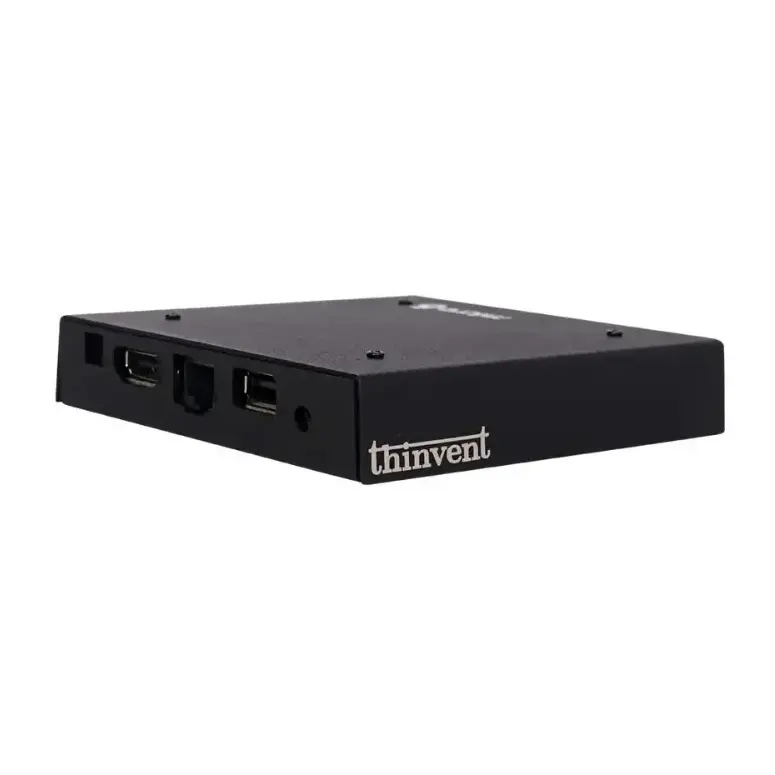
While Thinvent does not manufacture the Dell Pro Tower, we specialize in robust, fanless industrial computers that serve similar professional and industrial roles with enhanced reliability. Our product lines, such as the Aero Mini PC series, are engineered for 24/7 operation in challenging environments. Featuring efficient Intel processors like the N100, these systems offer silent, maintenance-free operation with wide temperature tolerance. They are perfect for edge computing, digital signage, kiosks, and factory automation where space, durability, and silence are critical. Explore our range to find a compact, powerful alternative designed for industrial longevity.