What is a High-Performance Workstation?
A high-performance workstation is a specialized computer system engineered for demanding professional applications that require superior computational power, graphics capabilities, and reliability. Unlike standard desktop PCs, these systems are built with server-grade components, support for ECC (Error-Correcting Code) memory, and professional-grade graphics cards to handle intensive tasks in fields like engineering, scientific research, media production, and data analysis. They are designed for 24/7 operation, offering exceptional stability and expandability to meet evolving project needs.
Key Specifications and Technical Details
True workstation-class systems are defined by several critical specifications. They typically feature high-core-count processors from Intel's Xeon W or Core i9 series, supporting multi-threaded workloads. A minimum of 32GB of RAM, often ECC for data integrity, is standard, with support for 128GB or more. Storage configurations prioritize speed and redundancy, utilizing NVMe SSDs in RAID arrays. The most distinguishing feature is support for professional GPUs from NVIDIA's RTX A-series or AMD's Radeon Pro line, which are optimized for CAD, 3D rendering, and simulation software with certified drivers. Robust power supplies, extensive cooling solutions, and multiple PCIe expansion slots for add-in cards are also hallmarks of this class.
Use Cases and Applications
These powerful systems are indispensable in professional environments. In Engineering and CAD/CAM, they run software like AutoCAD, SolidWorks, and CATIA for complex 3D modeling and simulation. Media and Entertainment professionals rely on them for 4K/8K video editing, visual effects (VFX), and 3D animation using tools like Adobe Creative Suite, DaVinci Resolve, and Blender. In Scientific Research and Data Science, they accelerate data analysis, financial modeling, and computational simulations. Architecture and Construction firms use them for Building Information Modeling (BIM), while Product Design and Manufacturing sectors utilize them for digital prototyping and factory floor planning.
Comparison: Workstation vs. High-End Desktop
| Feature | High-Performance Workstation | High-End Consumer Desktop |
|---|---|---|
| Primary Use | Professional, mission-critical applications | Gaming, content creation, enthusiast use |
| CPU | Intel Xeon W, Core i9; ECC support optional | Intel Core i7/i9, AMD Ryzen 7/9 |
| GPU | Professional (NVIDIA RTX A, AMD Radeon Pro) | Consumer Gaming (NVIDIA GeForce, AMD Radeon) |
| Memory | ECC support, 32GB+ standard, higher max capacity | Non-ECC, 16-32GB standard |
| Reliability | 24/7 operation, component validation, ISV certified | Not validated for continuous heavy loads |
| Expandability | Multiple PCIe slots, tool-less chassis | Limited by consumer motherboard design |
| OS Support | Windows 11 Pro for Workstations, Linux | Windows 11 Home/Pro |
Thinvent's Industrial Computing Solutions
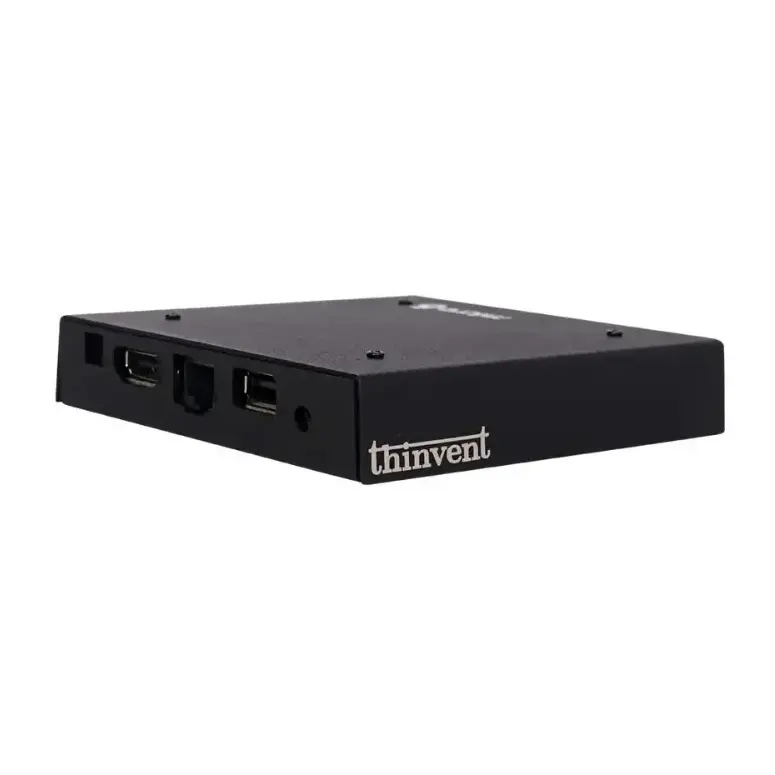
While Thinvent specializes in robust, fanless industrial computers and panel PCs, our product philosophy aligns with the core workstation tenets of reliability and performance in challenging environments. Our high-end Industrial PC form factors are built for 24/7 operation with wide-temperature components and durable enclosures, making them ideal for industrial automation, machine vision, and edge computing applications that demand workstation-level uptime. For users requiring powerful, space-efficient solutions, our Mini PCs with latest-generation Intel Core i5 and i7 processors offer a compact footprint without sacrificing processing capability for digital signage, kiosks, or control systems. Explore our range to find a resilient computing solution engineered for your professional needs.