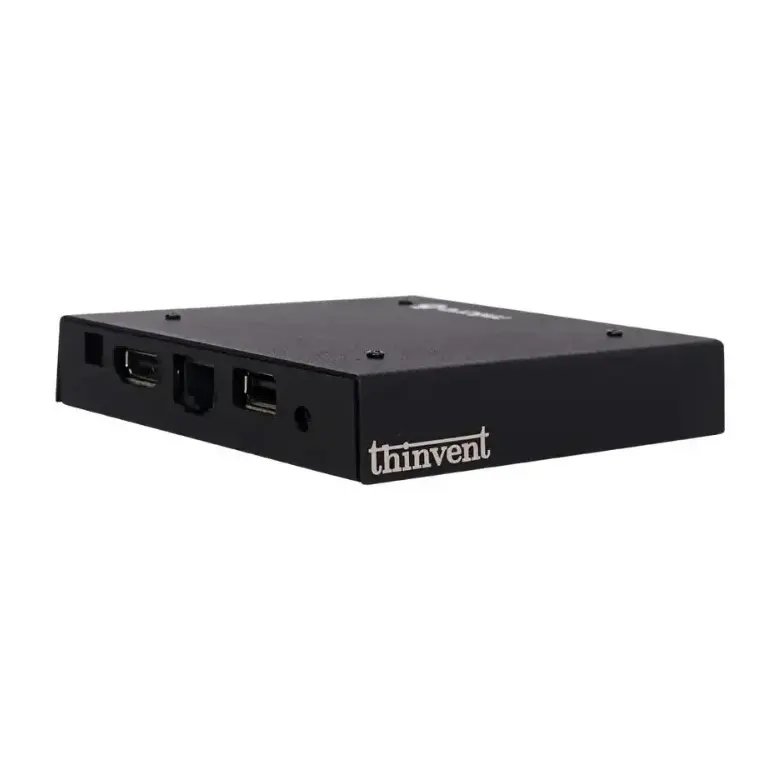
The Dell Wyse 3040 is a cost-effective thin client suited to light multitasking and basic productivity, running Wyse ThinLinux or ThinOS. The closest Thinvent alternative is the Thinvent Aero Mini PC, which spans Intel Core i3 to Core i5 and Core Ultra 5 processors, with RAM options up to 64 GB and SSD options up to 2 TB.
Dell Wyse Desktop vs Thinvent Aero Mini PC
| Dell Wyse 3040 | Thinvent Aero Mini PC, Intel Core i3 to i5 | Thinvent Aero Mini PC, Intel Core Ultra 5 | |
|---|---|---|---|
| Processor | Not stated | Intel Core i3-1215U to Core i5-1335U | Intel Core Ultra 5 125U |
| Cores/Threads | Not stated | 6 to 12 cores | 12 cores |
| RAM | Not stated | 4 GB to 64 GB | 8 GB to 64 GB |
| Storage | Not stated | 32 GB to 2 TB SSD | 32 GB to 2 TB SSD |
| Form Factor | Thin client | Mini PC | Mini PC |
| Operating System | Wyse ThinLinux or ThinOS | DOS | DOS |
| Wireless | Not stated | No WiFi or Wi-Fi 5 (802.11ac), dual band | No WiFi or Wi-Fi 5 (802.11ac), dual band |
Key differences
-
Thinvent Aero Mini PC models offer RAM up to 64 GB, where the Dell Wyse 3040 specifications available to us do not state a RAM maximum.
-
Thinvent Aero Mini PC models offer SSD storage up to 2 TB, giving room for large local data sets.
-
Thinvent Aero Mini PC models span several Intel Core processor generations, from the 12th to the 14th generation, so buyers can match performance to workload.
-
The Dell Wyse 3040 is positioned as a thin client for light multitasking, while the Thinvent Aero Mini PC is a full mini PC with a choice of processor and memory configurations.
-
Wireless options on the Thinvent Aero Mini PC are available as Wi-Fi 5 dual band or no Wi-Fi, so buyers can choose the connectivity they need.
Which one should you choose?
Choose the Dell Wyse 3040 if you need a thin client running Wyse ThinLinux or ThinOS for basic productivity tasks in a managed environment. Choose the Thinvent Aero Mini PC if you need a mini PC with a more capable Intel Core processor, larger memory and storage options, and a choice of wireless connectivity.