What Makes the Best Desktop Computer?
The "best" desktop computer depends entirely on where it will be used. For an office desk, a compact mini PC with a modern Intel processor and fast SSD delivers snappy everyday performance. For a factory floor, warehouse, kiosk or control cabinet, the best desktop computer is one built to survive heat, dust, vibration and 24/7 operation — not a consumer tower with a spinning fan that pulls in debris.
A practical way to judge any desktop is by four things: the processor, memory, storage and thermal design. A 12th-generation Intel Core i3-1215U, for example, offers 6 cores (2 performance + 4 efficient), up to 4.4 GHz turbo frequency and 10 MB of cache — more than enough for multitasking, point-of-sale software, dashboards and light industrial applications. Pairing that with 16 GB DDR4 RAM and a 1 TB SSD gives fast boot times, quick application launches and ample room for local data.
Key Specifications to Compare
| Specification | What It Affects | Typical Good Choice |
|---|---|---|
| Processor | Speed, multitasking, longevity | Intel Core i3/i5, 12th gen or newer |
| Cores / Threads | Running many apps at once | 6 cores and up |
| RAM | Smooth multitasking | 8–16 GB DDR4 |
| Storage | Boot speed, capacity | 256 GB–1 TB SSD |
| Cooling | Reliability in dusty/hot sites | Fanless (passive) design |
| Ports | Peripherals, legacy devices | Multiple USB, HDMI, dual Ethernet, serial |
| Operating System | Software compatibility | Windows 11 Pro, Linux, or without OS |
Why Fanless Cooling Matters
Fans are the single most common point of failure in a desktop computer. They draw in dust, lint and metal particles, clog heatsinks and eventually seize. In a fanless design, heat travels through the chassis itself, so there are no moving parts to wear out and no air intakes to clog. That means silent operation, far less maintenance and reliable performance in temperatures and environments where ordinary desktops struggle. Fanless systems are also ideal for clean environments such as clinics, studios and customer-facing counters, where noise and dust ingress are unwelcome.
Common Use Cases
-
Office and business desks — documents, browsing, video calls and ERP/CRM software
-
Retail and hospitality — point-of-sale terminals, billing counters, kiosks
-
Industrial automation — machine control, HMI, data logging, SCADA front-ends
-
Surveillance and networking — NVR management, edge processing, gateway duties
-
Thin client and VDI deployments — remote desktop sessions from a central server
-
Digital signage and education — always-on displays and lab machines
Choosing the Right Form Factor
Mini PCs suit desks and kiosks where space is tight. Industrial PCs add wide-voltage input, serial ports, mounting options and extended temperature tolerance. All-in-one computers integrate the screen and PC into one unit, ideal for counters and reception areas. Thin clients are the most cost-effective option when computing power lives in a data centre and only the display needs to be local. Matching the form factor to the environment matters more than chasing the highest benchmark score.
Thinvent's Desktop Computers
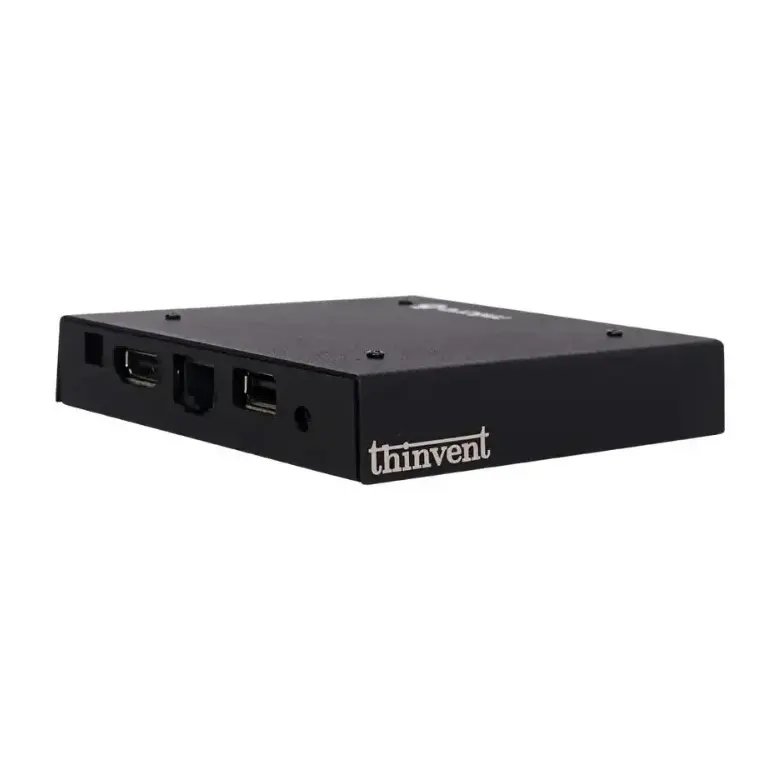
Thinvent builds industrial computers, mini PCs, thin clients and all-in-one PCs designed for exactly these demanding roles. Our Industrial PC IPC3, for instance, pairs an Intel Core i3-1215U processor (6 cores, up to 4.4 GHz, 10 MB cache) with 16 GB DDR4 RAM and a 1 TB SSD, and is available with Windows 11 Pro, Windows 11 IoT, DOS, Thinux Embedded Linux or no operating system at all. Options include quad DB9 serial ports for legacy equipment and fanless chassis for dusty, hot or always-on sites. Whatever your deployment — a single front desk or a thousand-node rollout — Thinvent has a desktop-class system built to keep running.