What Are Industrial Embedded Computing Solutions?
Industrial embedded computing solutions refer to specialized, ruggedized computer systems designed for integration into larger machines, equipment, or operational technology (OT) environments. Unlike consumer PCs, these systems are built to operate reliably 24/7 in harsh conditions—extreme temperatures, vibration, dust, and humidity—while delivering deterministic performance for real-time control, data acquisition, and edge processing.
Key Specifications of Industrial Embedded Computers
Modern embedded computing platforms for industrial use typically feature:
-
Fanless, passive cooling for silent, maintenance-free operation in dirty environments
-
Wide temperature range support (often -20°C to 70°C or wider)
-
Multiple I/O options including serial ports (RS-232/422/485), GPIO, CAN bus, and dual Ethernet for industrial networking
-
Low power consumption (5W–65W typical) enabling DC power from 12V or 24V industrial supplies
-
Extended lifecycle support (5–10+ years) to match long production runs
-
Real-time operating system support (RT Linux, Windows IoT Enterprise, VxWorks)
Processors range from energy-efficient ARM Cortex-A series (4 cores, up to 2.0 GHz) for IoT gateways and simple controllers, to high-performance Intel Core i5/i7 (6–12 cores, up to 5.0 GHz) for machine vision, AI inference, and data aggregation at the edge.
Applications in Industrial Electronics
Embedded computing technology powers critical functions across industries:
-
Factory automation: PLC controllers, robotic controllers, HMI panels
-
Energy & utilities: Smart grid gateways, renewable energy monitoring
-
Transportation: In-vehicle computers, rail signaling, traffic management
-
Medical devices: Diagnostic equipment, patient monitors
-
Retail & logistics: POS systems, warehouse automation, kiosks
A typical industrial edge gateway might use a 4-core ARM processor with 2–4 GB RAM and 16–64 GB storage for protocol conversion (Modbus to MQTT), while a machine vision system demands a 12th-gen Intel i5 with 16 GB RAM and 512 GB SSD to process high-resolution camera feeds in real time.
| Feature | Entry-Level (ARM-based) | Mid-Range (Intel N-series) | High-Performance (Intel Core i5) |
|---|---|---|---|
| Processor | 4-core Cortex A53/A55 @ 1.5–2.0 GHz | 4-core N100 @ 3.4 GHz | 10–12 core i5-1240P/120U @ 4.4–5.0 GHz |
| RAM | 2–4 GB onboard | 4–8 GB DDR4 | 8–32 GB DDR4 |
| Storage | 16–64 GB eMMC | 128–256 GB SSD | 256–512 GB SSD |
| Power | 5V/2A (10W) | 12V/5A (60W) | 12V/7A (84W) |
| OS | Embedded Linux | Ubuntu/Windows IoT | Windows IoT/Ubuntu |
| Typical Use | IoT gateway, sensor hub | Edge controller, HMI | Machine vision, AI inference |
Thinvent’s Industrial Embedded Computing Portfolio
Thinvent offers a comprehensive range of industrial embedded computing solutions tailored to diverse operational technology requirements:
-
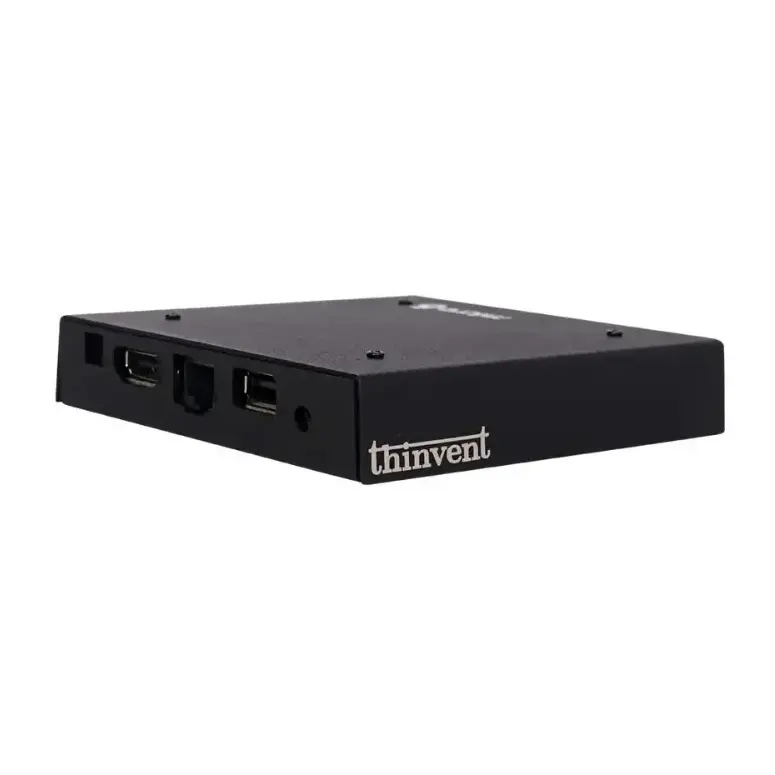
Thinvent Industrial PC (IPC) Series: Rugged fanless systems with Intel Core i3/i5 processors (12th gen), 8–16 GB DDR4 RAM, and 256–512 GB SSDs. Designed for 24/7 operation in factory floors, with wide voltage DC input and optional DIN-rail mounting. Available with Windows 11 IoT Enterprise or Ubuntu Linux.
-
Thinvent Micro Series (ARM-based): Ultra-compact, low-power embedded computers featuring ARM Cortex-A53/A55 quad-core processors, 2–4 GB onboard RAM, and 16–64 GB eMMC storage. Ideal for IoT gateways, edge data collection, and simple automation tasks. Ships with Thinux™ Embedded Linux for optimized real-time performance.
-
Thinvent Aero/Treo Mini PCs: Compact yet powerful units with Intel N100 or Core i3/i5 processors (12th/14th gen), 4–32 GB RAM, and 128–512 GB SSD storage. Suitable for edge computing, digital signage, and control applications where space is limited but performance matters.
All Thinvent industrial embedded systems feature fanless thermal design, extended temperature support, multiple industrial I/O options, and long-term availability to match your product lifecycle