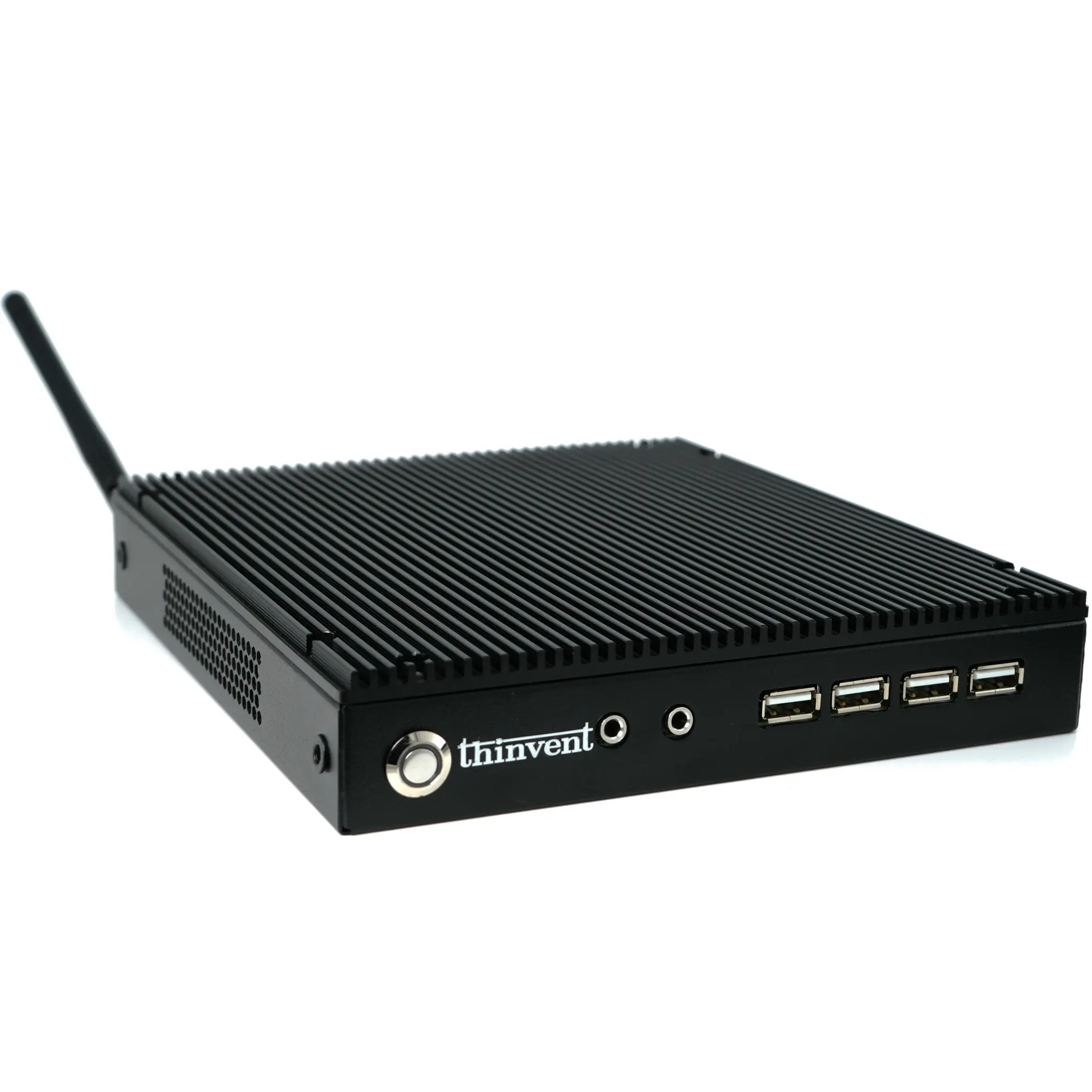
What Are Fanless Mini PCs?
Fanless mini PCs are compact computing systems designed to operate without internal cooling fans. They rely on passive cooling techniques, such as advanced heat sinks and chassis designs, to dissipate heat. This design eliminates moving parts, making them exceptionally reliable for demanding environments where dust, vibration, or noise are concerns. These systems are ideal for embedded applications, digital signage, and industrial automation where consistent, maintenance-free operation is critical.
Key Specifications and Technical Advantages
The core of a modern fanless mini PC is typically a low-power, high-efficiency processor from Intel's N-series (like the N100) or similar. Key specifications include:
-
Processor: Energy-efficient Intel CPUs (e.g., 4-core N100) with integrated graphics.
-
Memory: Configurations from 4GB to 16GB of DDR4 RAM.
-
Storage: Solid-state drives (SSD) from 128GB to 1TB for fast, reliable data access.
-
Connectivity: Multiple USB ports (including USB 3.2), Gigabit Ethernet, HDMI/DisplayPort outputs, and optional Wi-Fi.
-
Power: Low-voltage DC input (e.g., 12V), enabling easy deployment with power-over-Ethernet (PoE) adapters or standard adapters.
The primary technical advantage is the fanless, sealed design. This provides ingress protection against dust and particulates, allows for silent operation, and significantly reduces the risk of failure compared to systems with fans. They often support wide operating temperature ranges and feature robust metal enclosures.
Applications and Use Cases
Due to their ruggedness and small form factor, fanless mini PCs are deployed across numerous industries:
-
Industrial Automation: As PLCs or HMIs on the factory floor.
-
Digital Signage & Kiosks: Powering displays in retail, hospitality, and public transport.
-
Thin Clients & VDI: Durable endpoints for virtual desktop infrastructure.
-
Edge Computing: Data processing in remote or harsh locations (e.g., telecommunications, agriculture).
-
Embedded Systems: Within medical devices, gaming machines, and transportation systems.
Comparison: Fanless vs. Traditional Mini PCs
| Feature | Fanless Mini PC | Traditional Mini PC (with Fan) |
|---|---|---|
| Cooling | Passive (heat sinks) | Active (internal fan) |
| Noise | Silent | Audible fan noise |
| Dust Resistance | High (sealed chassis) | Lower (requires air intake) |
| Reliability | Higher (no moving parts) | Lower (fan is a failure point) |
| Performance Profile | Optimized for efficiency & sustained loads | Can handle higher, burstier thermal loads |
| Ideal For | 24/7 operation, harsh/dirty environments | Office, home, controlled environments |
Thinvent Fanless Mini PCs
Thinvent specializes in robust, fanless industrial computing solutions. Our Aero Mini PC series exemplifies this commitment, featuring the efficient Intel N100 processor in a compact, all-metal chassis. These systems are pre-configured with substantial memory and storage (like 16GB RAM and 128GB SSD) and offer flexible operating system choices, including Windows 11 IoT/Pro, Ubuntu Linux, and our proprietary Thinux™ Embedded Linux. Built for reliability in challenging conditions, Thinvent fanless PCs are perfect for embedded deployments, digital signage, and edge computing applications worldwide.