What You Need to Host Your Own Server
Hosting your own server requires a reliable, always-on computer with sufficient processing power, memory, storage, and network connectivity. Unlike a standard desktop, a server must handle continuous workloads, manage multiple requests, and operate stably 24/7. Key considerations include a capable multi-core processor for handling concurrent tasks, ample RAM for smooth operation of server software and caching, fast SSD storage for quick data access, and robust wired Ethernet for a stable network connection. A fanless, compact design is also advantageous for quiet, low-maintenance operation in various environments.
Key Specifications for a Home or Small Business Server
For a personal or small office server, the following technical specifications provide an excellent balance of performance and efficiency:
-
Processor: A modern, efficient multi-core CPU (e.g., Intel's N-series) is ideal. It provides enough power for web hosting, file sharing, media streaming, or running game servers without excessive heat or power consumption.
-
Memory (RAM): 8GB is a good starting point for basic tasks, while 16GB or more is recommended for hosting multiple services, databases, or virtual machines.
-
Storage: A Solid State Drive (SSD) is essential for fast boot times and quick data access. A 256GB or 512GB SSD provides ample space for the operating system, applications, and initial data, with options for expansion via external drives or network storage.
-
Connectivity: Gigabit Ethernet (1000 Mbps) is non-negotiable for fast and reliable network throughput. Multiple USB ports (including USB 3.2 and USB-C) are useful for connecting backup drives or peripherals.
-
Operating System: The choice depends on your needs. Linux distributions like Ubuntu Server are popular for their stability, security, and low resource use. Windows-based solutions are also viable for certain applications or user familiarity.
Common Use Cases and Applications
A compact, industrial-grade mini PC is perfectly suited for a variety of server roles:
-
Media Server: Stream movies, music, and photos to devices on your home network using software like Plex, Jellyfin, or Emby.
-
File/Backup Server: Create a centralized location for storing and backing up important documents and family photos, accessible from any device.
-
Web Development Server: Host a local web server (like Apache or Nginx) for developing and testing websites and applications.
-
Home Automation Hub: Run software like Home Assistant to control and automate smart home devices from a single, reliable platform.
-
Game Server: Host private servers for popular games, providing a controlled environment for you and your friends.
Comparison of Server Types
| Server Type | Typical Hardware | Best For | Pros | Cons |
|---|---|---|---|---|
| Dedicated Server | Full-sized tower or rackmount | Large businesses, high-traffic websites | Maximum power, full customization, expansion | Expensive, large, noisy, high power use |
| Mini PC Server | Compact, fanless industrial PC | Home users, small businesses, developers | Small footprint, quiet, energy-efficient, reliable | Limited internal expansion (uses external storage) |
| Cloud Server | Virtual machine on provider hardware | Scalable projects, global access | Instant setup, scalable, no hardware maintenance | Ongoing subscription costs, less control, data off-site |
Thinvent Solutions for Server Hosting
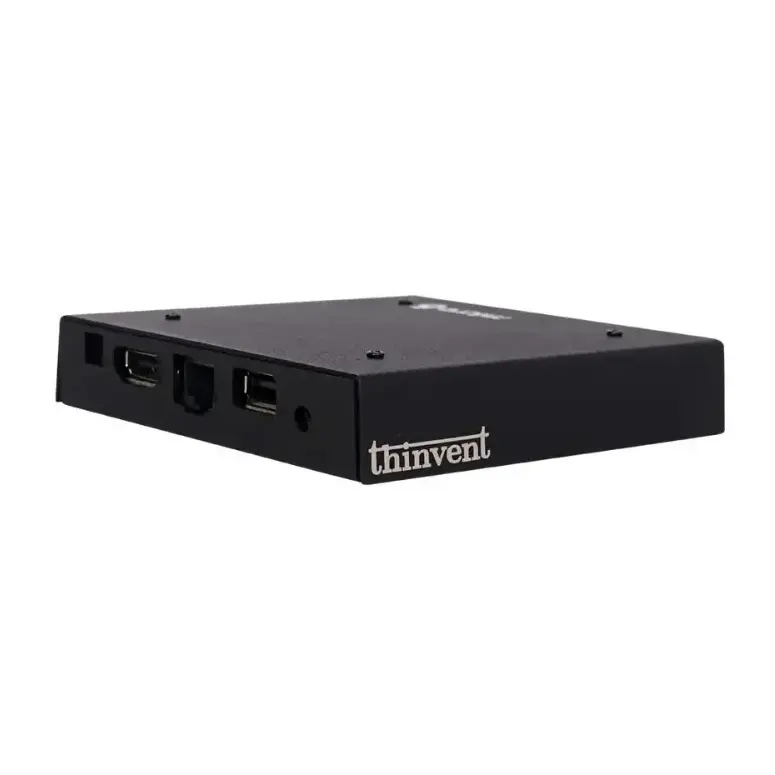
Thinvent offers a range of robust, fanless industrial mini PCs that are engineered for 24/7 operation, making them an excellent foundation for your own server. Our systems, like the featured Aero Mini PC, combine efficient Intel processors with generous DDR4 RAM and fast SSD storage in a compact, silent chassis. They come with multiple OS options, including Windows 11 Pro for specific applications or a clean slate with FreeDOS for installing your preferred Linux distribution. Built with industrial-grade components for reliability and featuring Gigabit Ethernet for solid network performance, Thinvent mini PCs provide a professional, dependable, and energy-efficient hardware solution for hosting personal or business-critical services.