What "IST" Means in Industrial Computing
"IST" is most commonly read as India Standard Time — the UTC+05:30 time zone — and it shows up frequently in industrial computing because so much automation, data logging and remote monitoring depends on accurate, correctly stamped timestamps. When a factory, substation or retail chain runs equipment across multiple regions, every log entry, alarm and production record has to carry a consistent time reference. Industrial computers that are configured for a specific time zone, or that synchronise against an NTP server, are therefore a routine requirement rather than an unusual one.
If you arrived here searching for "IST" in a different sense — for example an acronym used by a specific software package, an SCADA tag, or a model reference — the underlying need is almost always the same: a rugged, always-on computer that can run your application reliably, keep time accurately, and survive the conditions of a plant floor or an outdoor cabinet.
Why Time Accuracy Matters on the Factory Floor
Industrial systems rarely fail because of raw computing power. They fail because of drift — a controller whose clock slips by a few seconds a day, a data logger that stamps events inconsistently, or a gateway that loses its time reference after a power cut. Over a month, a small drift compounds into records that cannot be correlated across machines, which makes fault diagnosis and compliance reporting far harder than it needs to be.
The practical fixes are well established: run an NTP or PTP client, keep a real-time clock with a backup battery on the board, and choose hardware that boots predictably after power loss. An industrial PC with a coin-cell-backed RTC and a stable power supply will hold time across short outages and re-sync cleanly once the network returns.
Hardware That Supports Time-Critical Applications
| Requirement | What to Look For | Typical Spec |
|---|---|---|
| Accurate timestamps | Battery-backed RTC, NTP/PTP support | RTC with coin cell |
| Always-on operation | Fanless design, wide-temperature components | 0–50 °C or wider |
| Network time sync | Wired Ethernet, dual ports for redundancy | 2 × Gigabit Ethernet |
| Legacy equipment links | Serial ports for meters, PLCs, weighbridges | RS-232/RS-485 DB9 |
| Unattended uptime | Auto power-on after AC restore | BIOS power-on setting |
| Local processing | Enough CPU and RAM for logging software | 6-core CPU, 16 GB RAM |
Typical Applications
Time-synchronised industrial computers are used in production line monitoring, where each station stamps its output; in energy and utility substations, where event logs must align with grid records; in cold chain and logistics, where temperature excursions are timestamped; and in retail and banking networks, where transaction logs need a consistent clock across branches. In each case the computer is expected to run unattended for months, tolerate dust and vibration, and restart itself cleanly after a power interruption.
Thinvent Industrial PCs for Always-On Deployments
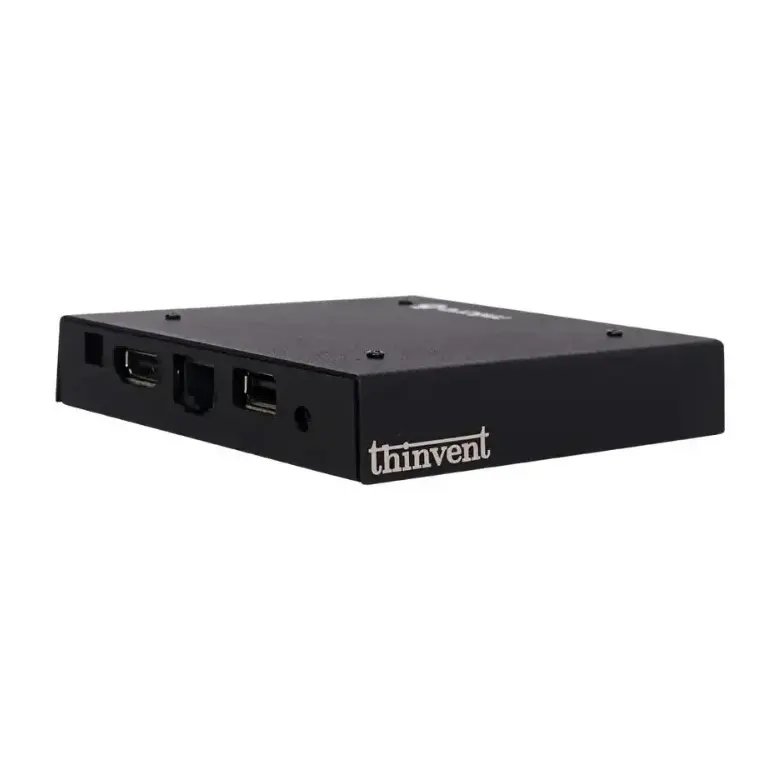
Thinvent's IPC3 series is built for exactly this class of workload. Configurations pair an Intel® Core™ i3-1215U processor (6 cores, up to 4.4 GHz, 10 MB cache) with 16 GB DDR4 memory and a 1 TB SSD, in a fanless chassis with no moving parts to attract dust or fail. Wired Gigabit Ethernet keeps NTP synchronisation stable, and variants with quad DB9 serial ports connect directly to PLCs, energy meters and legacy instruments without adapters. You can order the IPC3 with Windows 11 Pro, Windows 11 IoT Value, DOS, or Thinux™ Embedded Linux, so the operating system matches your application stack rather than forcing a change to it.