What Are Industrial Servers for Automation and Control?
Industrial servers for automation and control are ruggedized computing platforms designed to run continuously in factories, plants, and process environments. Unlike office-grade servers, they are built to tolerate dust, vibration, wide temperature swings, and 24/7 operation while interfacing directly with PLCs, sensors, drives, and SCADA/HMI software. In practice, most automation and control deployments rely on compact industrial PCs and edge servers rather than rack-room hardware, because the compute needs to sit close to the machine it controls.
Key Specifications That Matter
When selecting a platform for automation and control, the priorities are I/O, reliability, and long-term availability rather than raw clock speed.
| Requirement | Why It Matters | Typical Specification |
|---|---|---|
| Fanless cooling | No dust ingress, no moving parts to fail | Passive aluminium chassis |
| Serial ports | PLCs, VFDs, weighbridges, legacy instruments | RS-232/RS-485 DB9 |
| Wide DC input | Runs from control cabinet power | 12V DC adapter input |
| Dual Ethernet | Separates plant network from IT network | 2 × Gigabit LAN |
| Operating system | Real-time and headless control stacks | Windows 11 Pro, Linux, DOS |
| Storage | Logging, historians, local HMI data | 128 GB – 1 TB SSD |
Processors such as the Intel® Core™ i3-1215U (6 cores, up to 4.4 GHz, 10 MB cache) are a common sweet spot: enough performance for SCADA servers, vision pre-processing, and multi-tab HMI applications, while staying within a fanless thermal envelope. Memory of 8–16 GB DDR4 is generally sufficient for control software, databases, and OPC UA servers running concurrently.
Use Cases and Applications
Industrial servers for automation and control are deployed in several distinct roles:
-
SCADA and HMI servers – hosting supervisory software, alarm management, and historical trending on the plant floor.
-
Edge gateways – collecting data from PLCs and Modbus/OPC devices and forwarding it to MES or cloud systems.
-
Machine control cabinets – running soft-PLC or motion control software directly alongside the equipment.
-
Vision and inspection – handling camera streams for quality checks on production lines.
-
Building and utility automation – HVAC, energy metering, water treatment, and access control.
Because these systems often sit in sealed cabinets with limited airflow, a fanless industrial PC with solid-state storage and a wide-temperature design is usually preferred over a conventional tower or rack server.
Choosing the Right Form Factor
There is no single answer to "which industrial server" — the correct choice depends on where the unit will live. Cabinet-mounted DIN or wall-mount industrial PCs suit machine-level control. Compact mini PCs work well as edge nodes where only gateway functions are needed. All-in-one panel PCs combine the display and computer for operator stations, reducing wiring and panel space. For deployments that need many serial connections, a model with quad DB9 ports avoids adding external converters, which are a common point of failure in plant environments.
Thinvent Products Featuring This Technology
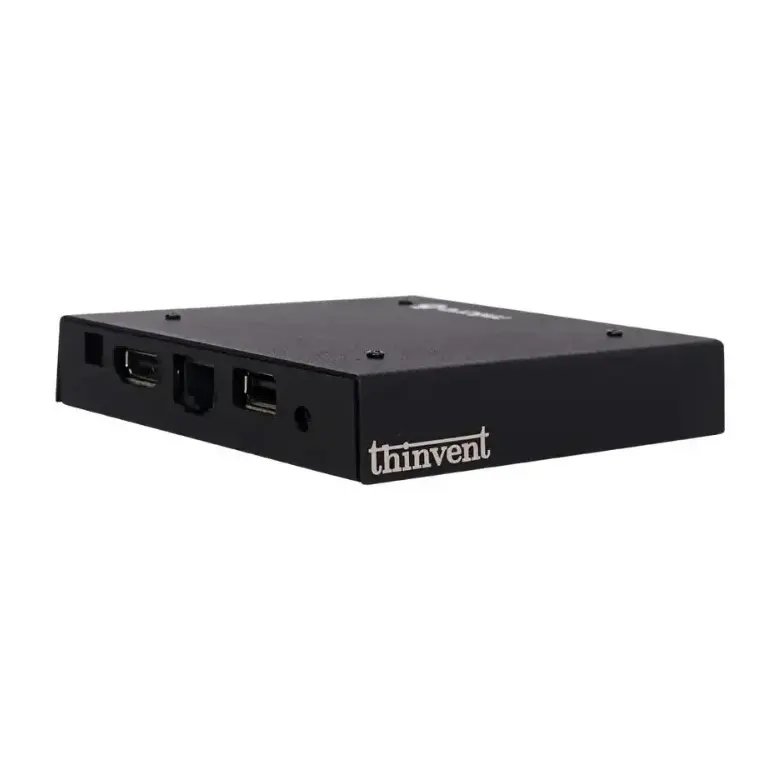
Thinvent builds fanless industrial computers and edge platforms suited to automation and control workloads. The Thinvent® Industrial PC IPC3, powered by an Intel® Core™ i3-1215U processor (6 cores, up to 4.4 GHz, 10 MB cache) with 16 GB DDR4 RAM and up to 1 TB SSD, is available with quad DB9 serial ports for direct PLC and instrument connectivity. Operating system options include Windows 11 Professional, Windows 11 IoT Value, DOS, and Thinux™ Embedded Linux, so the same hardware can serve SCADA, soft-PLC, or embedded control roles. The fanless, 12V DC design keeps the unit reliable in dusty cabinets and on 24/7 duty cycles.