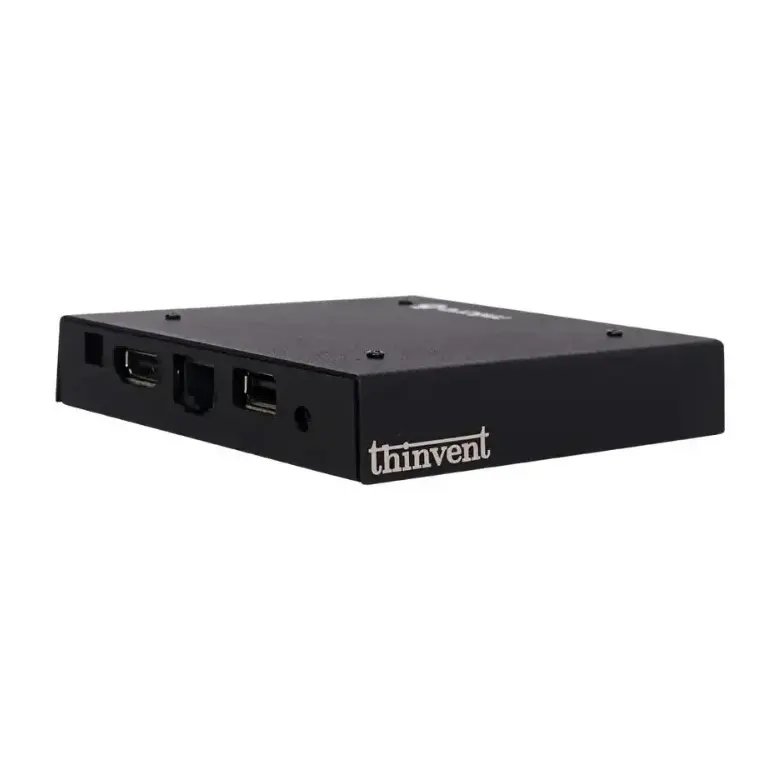
What Is an Industrial Computer?
An industrial computer is a ruggedized computing platform built to run continuously in environments where a standard office desktop or consumer mini PC would struggle — factory floors, kiosks, control cabinets, vehicles, and outdoor enclosures. Unlike commercial PCs, industrial systems are designed around three priorities: reliable 24/7 operation, tolerance of heat, dust, vibration and wide voltage input, and long-term availability of the same model so that a deployed fleet stays consistent for years.
The "main" computing unit in an industrial deployment is usually a compact, fanless box that sits inside a panel or cabinet and connects to sensors, PLCs, displays, scales, printers or cameras. Because there are no moving parts, there is no fan to clog with dust and no bearing to wear out — a key reason fanless designs dominate the category.
Key Specifications to Evaluate
| Specification | Typical Range | Why It Matters |
|---|---|---|
| Processor | Intel Celeron, N-series, Core i3/i5 (7th–14th gen) | Balances compute, power draw and passive cooling limits |
| Cores | 4 to 12 | More cores help with multitasking, VM and edge workloads |
| Memory | 4 GB – 64 GB DDR4/DDR5 | Drives responsiveness of SCADA, HMI and database software |
| Storage | 128 GB – 1 TB SSD | Silent, shock-resistant, faster than spinning disks |
| Display output | 1–2 × HDMI | Dual display for control room and machine-side screens |
| Ethernet | Gigabit, single or dual ports | Dual NICs separate control and corporate networks |
| Serial | DB9 RS-232/485 | Legacy PLCs, weighbridges, meters and instruments |
| Power | 12 V DC adapter or wide-range DC input | Matches industrial power supplies and battery systems |
| Operating system | Windows 11 Pro/IoT, Linux, DOS, or OS-free | Determines software compatibility and licensing cost |
The processor choice usually drives everything else. Low-power Intel N-series and Celeron chips suit always-on kiosks and data logging, while Core i3 and i5 parts handle machine vision, multi-display dashboards and virtualized edge workloads. Passive (fanless) cooling keeps the enclosure sealed against airborne contaminants, which is why industrial units often trade peak clock speed for thermal headroom.
Common Use Cases
Industrial computers appear wherever a general-purpose PC must survive a difficult location. Typical applications include:
-
Factory automation and HMI — running SCADA software, driving touch panels, logging production data
-
Machine vision and inspection — feeding cameras and cameras' image-processing pipelines on the line
-
Kiosks and self-service terminals — ticketing, check-in