What Makes a Compact Industrial PC Reliable?
A compact industrial PC is a small-footprint computer engineered to operate continuously in environments where ordinary office desktops would struggle — factory floors, control cabinets, kiosks, and outdoor enclosures. Reliability in this class comes from three things: fanless thermal design, wide-temperature-rated components, and a rugged chassis that resists dust, vibration, and electrical noise. Because there are no moving parts like cooling fans or spinning hard disks, a well-built industrial PC can run 24/7 for years with minimal maintenance.
Compact industrial PCs typically measure a few litres in volume and mount via DIN rail, VESA bracket, or wall plate, so they fit inside tight control panels. They usually accept a wide DC input range (commonly 9–36V), support extended operating temperatures, and offer industrial I/O such as multiple serial ports (RS-232/RS-485), isolated digital I/O, and dual Gigabit Ethernet for network redundancy.
Key Specifications to Look For
When choosing a compact industrial PC, focus on the specifications that determine long-term reliability rather than peak benchmark scores.
| Specification | Why It Matters |
|---|---|
| Fanless cooling | No dust ingress, no fan failure, silent operation |
| Wide DC input (9–36V) | Works from industrial power rails and battery systems |
| Operating temperature | Stable operation in hot cabinets or unheated enclosures |
| Dual Gigabit Ethernet | Network redundancy and separate control/IT networks |
| Serial ports (RS-232/485) | Direct connection to PLCs, sensors, and legacy equipment |
| SSD storage | Shock-resistant, no moving parts |
| Watchdog timer | Automatic recovery from software lock-ups |
Modern industrial PCs pair these rugged features with current-generation processors. Intel® Core™ i3 and Celeron® N-series chips, for example, deliver strong performance per watt while remaining easy to cool passively.
Typical Applications
Compact industrial PCs are used across manufacturing, energy, transportation, and retail. Common deployments include:
-
Machine control and HMI — running SCADA and human-machine interface software next to production equipment.
-
Data acquisition gateways — collecting data from PLCs, meters, and sensors over serial and Ethernet links.
-
Digital signage and kiosks — driving displays in unattended, dusty, or high-traffic locations.
-
Edge computing — pre-processing data locally before sending it to the cloud.
-
Transport and logistics — fleet terminals, weighbridge stations, and warehouse systems.
In all of these roles, the priority is uptime: the PC must keep running through heat, vibration, and power fluctuations without operator intervention.
Choosing the Right Configuration
Match the processor, memory, and storage to your software stack. Lightweight HMI and gateway tasks run comfortably on 4–8GB of RAM and a 128–256GB SSD, while vision, database, or multi-application workloads benefit from 16GB or more and a larger SSD. Consider the operating system carefully too — Windows 11 Pro and IoT editions suit commercial software, while embedded Linux offers a lean, licence-free option for dedicated appliances. Redundant Ethernet ports and multiple serial interfaces are worth specifying up front, since retrofitting them later is rarely possible.
Thinvent Industrial PCs Built for This Role
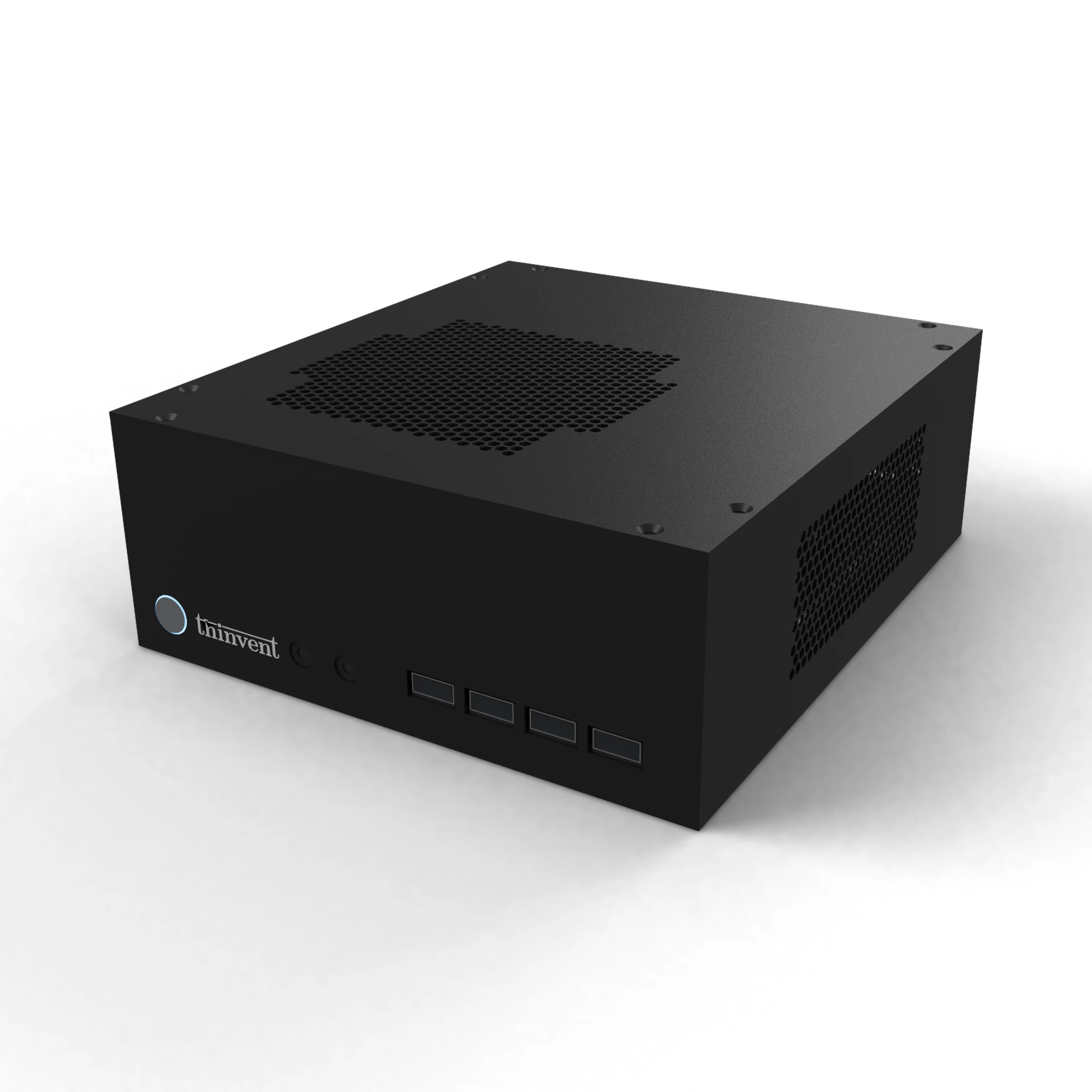
Thinvent manufactures compact industrial computers designed for continuous duty in tough environments. The Thinvent® IPC3 series combines a fanless chassis with Intel® Core™ i3-1215U processors (6 cores, up to 4.4 GHz, 10 MB cache), configurable up to 16GB DDR4 RAM and 1TB SSD storage. Models are available with Windows 11 Professional, Windows 11 IoT Value, DOS, or Thinux™ Embedded Linux, and options include quad DB9 serial ports for connecting PLCs and legacy industrial equipment. With wide DC input, dual Gigabit Ethernet, and no moving parts, Thinvent IPC3 units are built to stay online where ordinary PCs cannot.