What Are Raspberry Pi 5 Boards?
Raspberry Pi 5 boards are the latest generation of single-board computers (SBCs) from the Raspberry Pi Foundation, designed for hobbyists, educators, and developers. They offer a significant performance upgrade over previous models, featuring a quad-core Arm Cortex-A76 processor, dual 4K HDMI output, PCIe 2.0 support, and improved I/O capabilities. These compact, low-cost boards are popular for prototyping, learning to code, and building DIY electronics projects. However, for industrial and commercial deployments, their consumer-grade components and lack of formal certification can pose challenges for reliability, long-term support, and harsh environment operation.
Key Specifications and Technical Details
The Raspberry Pi 5 Model B is built around a Broadcom BCM2712 system-on-chip with a 2.4GHz quad-core 64-bit Arm Cortex-A76 CPU. It includes 4GB or 8GB of LPDDR4X RAM, dual 4Kp60 HDMI display outputs, and a PCIe 2.0 interface for high-speed peripherals. Connectivity features dual-band Wi-Fi 5, Bluetooth 5.0, Gigabit Ethernet, and two USB 3.0 ports alongside two USB 2.0 ports. It requires active cooling and a more robust power supply (5V/5A via USB-C) than its predecessors. While powerful for its size and price, it lacks features critical for industrial use, such as wide-range power input, extended temperature operation, and locking connectors.
Industrial Applications and Use Cases
In commercial and industrial settings, Raspberry Pi boards are often used for prototyping, digital signage, light automation, and as IoT gateways. However, for mission-critical applications, businesses frequently seek industrial-grade alternatives that offer greater durability, longer lifecycle support, and enhanced reliability. These applications include:
-
Factory Automation: Controlling machinery and monitoring sensors on the shop floor.
-
Digital Signage: Running displays in retail, transportation, and corporate environments.
-
Edge Computing: Processing data locally in IoT networks for smart cities and agriculture.
-
Kiosks and POS Systems: Powering interactive terminals and point-of-sale systems.
Comparing Raspberry Pi 5 with Industrial Mini PCs
For professional deployments, industrial mini PCs offer significant advantages over consumer SBCs like the Raspberry Pi 5.
| Feature | Raspberry Pi 5 (Consumer SBC) | Industrial Mini PC (e.g., Intel-based) |
|---|---|---|
| Processor | Arm Cortex-A76 (Quad-core) | x86 (Intel/AMD, various cores & generations) |
| OS Support | Linux-based (Raspberry Pi OS) | Windows, Linux, FreeDOS, Embedded OS |
| Reliability | Consumer components, limited temp range | Industrial-grade, wide temp range, fanless designs |
| Longevity | Short product lifecycle | Long-term availability & support (5-7+ years) |
| I/O & Expansion | GPIO pins, HATs, PCIe 2.0 | Standard industrial ports (COM, GPIO), M.2, PCIe |
| Power Supply | 5V/5A USB-C (specific) | Wide-range DC input (e.g., 9-36V) |
| Certifications | Basic CE/FCC | Industrial certifications (CE, FCC, possibly UL) |
Thinvent Industrial Computing Solutions
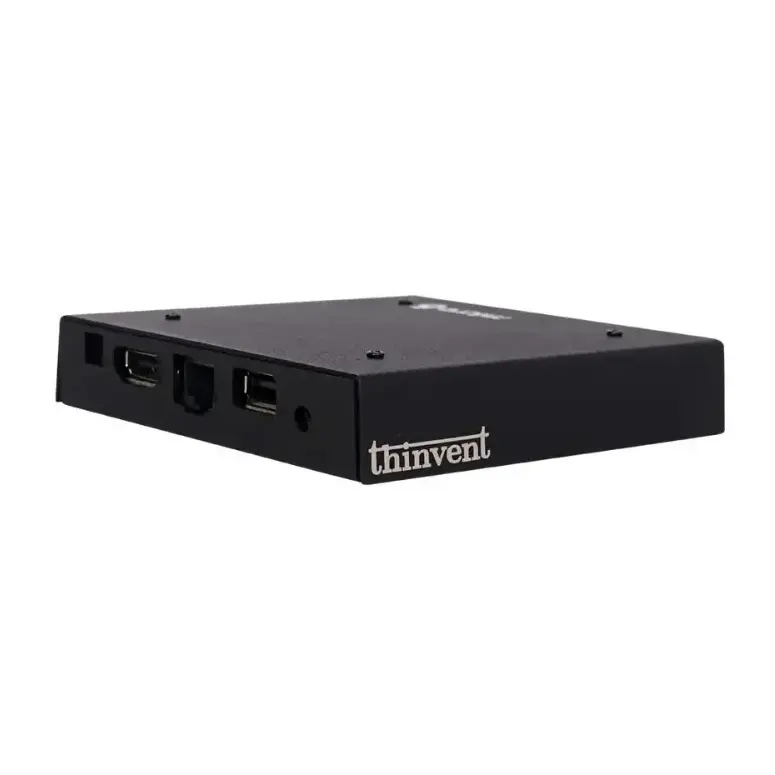
Thinvent provides robust, fanless industrial computers that serve as powerful and reliable alternatives to Raspberry Pi boards for commercial and industrial applications. Our systems are built with industrial-grade components for 24/7 operation in demanding environments, featuring wide-temperature operation, vibration resistance, and long-term product lifecycle support. Unlike consumer SBCs, Thinvent mini PCs support a full range of professional operating systems, including Windows 11 IoT Enterprise, Ubuntu Linux, and our own Thinux™ Embedded Linux, ensuring software compatibility and security. With a focus on durability, performance, and seamless integration, Thinvent computers are the preferred choice for system integrators and OEMs worldwide who require dependable computing power beyond the prototyping stage.