What Is a Ryzen 3 Desktop PC?
A Ryzen 3 desktop PC is a computer built around an AMD Ryzen 3 processor. The Ryzen 3 line sits at the entry level of AMD's desktop and mobile CPU families, typically offering 4 cores (and, in newer generations, up to 6 threads or cores depending on the specific SKU). These chips are designed for everyday productivity: office applications, web browsing, point-of-sale software, digital signage playback, and light multitasking.
The appeal of a Ryzen 3 system is its balance of cost, efficiency, and adequate performance for mainstream workloads. Many Ryzen 3 parts also include integrated Radeon graphics, which means the system can drive one or more displays without a discrete GPU. This makes them common in compact desktops, all-in-ones, and small-form-factor business machines.
Key Specifications to Consider
When evaluating any entry-level desktop, the specifications that matter most are core count, memory, storage, and connectivity. A typical Ryzen 3 configuration pairs 4 cores with 8 GB to 16 GB of DDR4 memory and a 256 GB to 1 TB SSD. Connectivity usually includes Gigabit Ethernet, HDMI output, and several USB ports.
| Specification | Typical Entry-Level Range | What It Means in Practice |
|---|---|---|
| Cores / Threads | 4C / 4T to 6C / 12T | Smooth office apps, light multitasking |
| Base / Boost Clock | ~3.0 GHz to 4.0+ GHz | Responsive everyday performance |
| Memory | 8–32 GB DDR4 | Enough for browsers, POS, kiosk software |
| Storage | 128 GB–1 TB SSD | Fast boot, quiet operation |
| Graphics | Integrated Radeon | 1–2 display output, no GPU needed |
| Ethernet | Gigabit (1000 Mbps) | Reliable wired networking |
Where Entry-Level Desktops Fit Best
Computers in this class are workhorses for environments where reliability and low maintenance matter more than raw speed. Common deployments include retail billing counters, factory-floor terminals running HMI or SCADA software, reception and front-desk systems, classroom and lab machines, and digital signage players. In these roles, a fanless or low-power design is often preferred because it reduces dust ingress, cuts noise, and improves long-term durability in hot or dusty settings.
Operating system choice also matters. Windows 11 Pro and Windows 11 IoT are common for commercial software compatibility, while Ubuntu Linux and embedded Linux distributions are popular for kiosks, gateways, and industrial control applications where licensing cost and long-term stability are priorities.
Choosing the Right Platform
If your software is validated on AMD platforms, a Ryzen 3 machine is a natural fit. If your application stack, drivers, or vendor certifications are built around Intel, then an Intel-based entry-level system is the safer choice. Either way, the practical checklist is the same: confirm the CPU meets your software's minimum requirement, size the RAM and SSD to your workload, and verify the I/O you need — serial ports, multiple HDMI outputs, dual Ethernet, and USB count.
Thinvent's Range for Entry-Level and Industrial Deployments
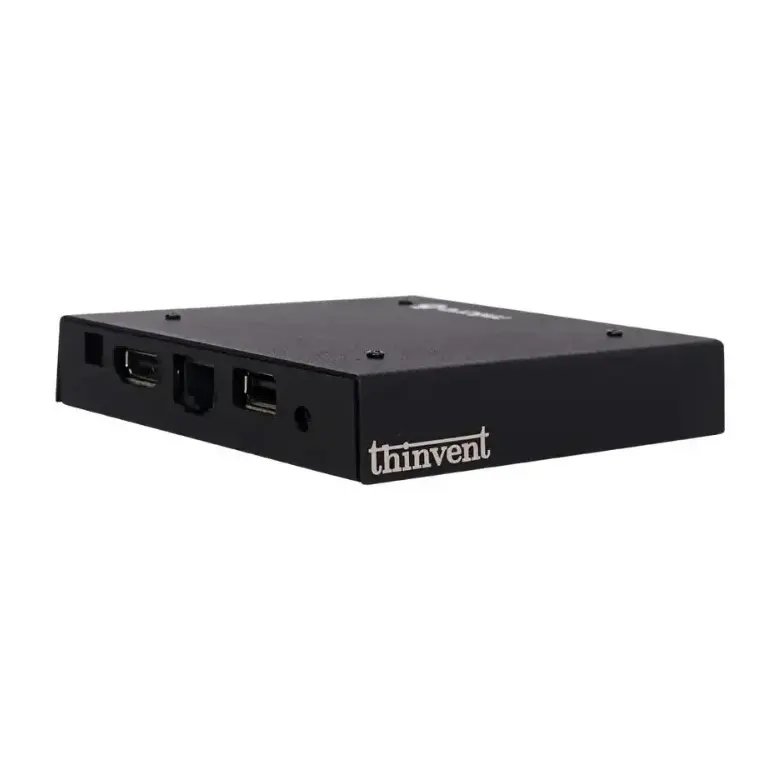
Thinvent manufactures industrial computers, mini PCs, thin clients, and all-in-one PCs built for continuous operation in demanding environments. Our entry-level and mid-range industrial PCs, such as the IPC3 series, pair efficient Intel Core i3 processors with up to 16 GB DDR4 RAM and 1 TB SSD storage, and are available with Windows 11 Pro, Windows 11 IoT, DOS, or Thinux Embedded Linux. For deployments that require AMD Ryzen 3-class performance, contact Thinvent to discuss the right configuration, I/O layout, and operating system for your application.