What is SATA?
SATA (Serial ATA) is a computer bus interface that connects host bus adapters to mass storage devices such as hard disk drives (HDDs), solid-state drives (SSDs), and optical drives. It is the standard interface for internal storage in most modern industrial and consumer computers, succeeding the older Parallel ATA (PATA) standard. SATA offers significant advantages in speed, cable management, and hot-swapping capabilities, making it a cornerstone of reliable data storage in demanding environments.
Key Specifications and Technical Details
The SATA interface has evolved through several revisions, each increasing data transfer speeds:
-
SATA Revision 1.0: 1.5 Gbit/s (150 MB/s)
-
SATA Revision 2.0: 3.0 Gbit/s (300 MB/s)
-
SATA Revision 3.0: 6.0 Gbit/s (600 MB/s) - This is the most common standard in current industrial PCs.
-
SATA Revision 3.2: Introduced SATA Express and other features, but 6 Gbit/s remains the dominant speed for the standard interface.
SATA uses a thin, seven-pin data cable and a separate power connector, which improves airflow and reduces clutter inside a computer chassis compared to the wide ribbon cables of PATA. Key features include native command queuing (NCQ) for improved performance, hot-plug support (in specific implementations), and backward compatibility between revisions.
Use Cases and Applications in Industrial Computing
SATA storage is ubiquitous in industrial computing due to its reliability, cost-effectiveness, and wide compatibility.
-
Data Logging & Acquisition: SATA SSDs and HDDs provide durable, high-capacity storage for continuous data recording from sensors and machinery.
-
Digital Signage & Kiosks: Reliable SATA SSDs ensure fast boot times and smooth media playback for 24/7 operation.
-
Thin Clients & Embedded Systems: Smaller form-factor SATA drives (like mSATA or M.2 SATA) are used in space-constrained applications where reliable local storage is needed.
-
Factory Automation: Industrial PCs use SATA storage to host operating systems, HMIs (Human-Machine Interfaces), and control software, benefiting from the interface's stability.
SATA vs. NVMe: A Quick Comparison
For modern systems, SATA often coexists with the faster NVMe (Non-Volatile Memory Express) protocol. Here's a basic comparison:
| Feature | SATA SSD | NVMe SSD (PCIe) |
|---|---|---|
| Interface / Protocol | SATA / AHCI | PCI Express / NVMe |
| Max Theoretical Speed | ~600 MB/s | ~3500 MB/s (PCIe 3.0) to ~7000+ MB/s (PCIe 4.0) |
| Use Case | Cost-effective bulk storage, general computing, legacy support. | High-performance workstations, data analytics, high-frequency trading. |
| Form Factor | 2.5", mSATA, M.2 (SATA key) | M.2, U.2, Add-in Card |
SATA remains the ideal choice for applications where extreme speed is less critical than cost, capacity, and proven reliability.
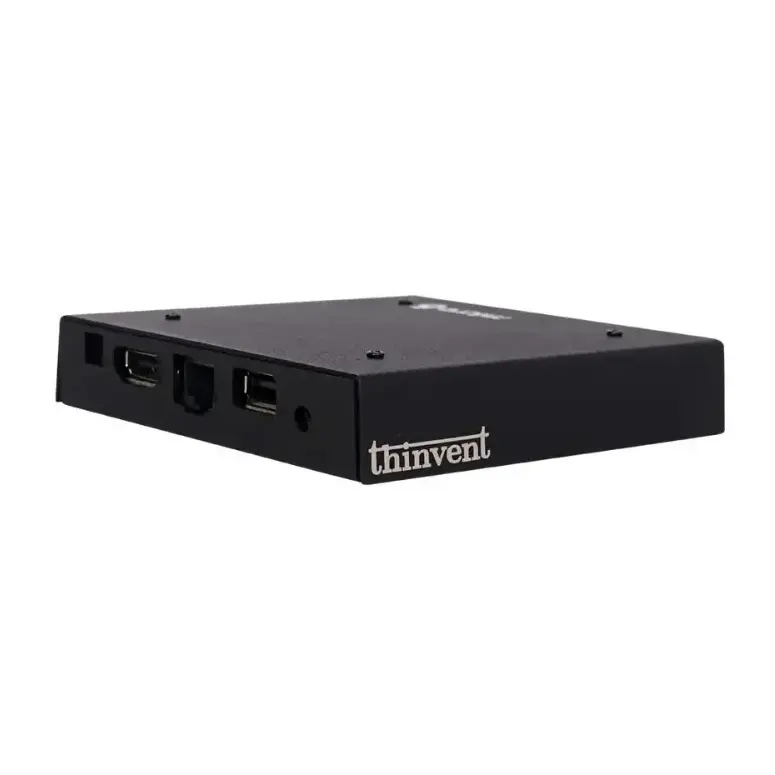
Thinvent Industrial Computers with SATA Storage
Thinvent integrates robust SATA storage solutions across its product line to ensure data integrity and system reliability. Our industrial computers, from compact Mini PCs to powerful workstations, support standard 2.5" SATA SSDs and HDDs, offering a balance of performance, capacity, and value. For applications requiring a blend of fast boot times and ample storage, many Thinvent systems feature dual storage options, combining a SATA drive for capacity with an NVMe drive for the operating system. This flexibility allows our global customers to tailor storage configurations precisely to their operational needs, whether for edge computing, industrial automation, or digital signage.