What Are Industrial Servers?
Industrial servers are purpose-built computing systems designed to operate reliably in harsh environments, supporting mission-critical applications in manufacturing, automation, edge computing, and data-intensive industries. Unlike standard commercial servers, industrial servers prioritize durability, extended temperature tolerance, vibration resistance, and long-term availability, ensuring consistent performance under demanding conditions. They typically feature robust construction, fanless cooling options, and high-quality components that withstand dust, humidity, and temperature extremes.
Key Specifications and Technical Details
Industrial servers differ from consumer-grade systems in several critical areas. They often use industrial-grade motherboards designed for 24/7 operation, with enhanced power management and extended lifecycle support. Key specifications to consider include:
-
Processor Performance: High-core-count processors (e.g., Intel Core i5/i7, Xeon) for multitasking and heavy workloads
-
Memory and Storage: ECC (Error-Correcting Code) RAM for data integrity, plus RAID-capable SSD/HDD storage for redundancy
-
Connectivity: Multiple Ethernet ports (often 2+ Gigabit or 10GbE), USB, serial ports, and expansion slots for industrial I/O
-
Environmental Tolerance: Operating temperature ranges from -20°C to 70°C, shock and vibration resistance (per MIL-STD-810G or similar)
-
Form Factors: Rack-mountable, DIN-rail, or wall-mountable designs for flexible deployment
For example, an industrial server might feature an Intel Core i5-1240P processor (12 cores, up to 4.4 GHz), 16GB DDR4 RAM with ECC support, 512GB NVMe SSD, dual Gigabit Ethernet ports, and a fanless chassis rated for 0-50°C operation.
Use Cases and Applications
Industrial servers are deployed across diverse sectors where reliability is non-negotiable:
-
Manufacturing and Automation: Running SCADA systems, PLC controllers, and real-time monitoring software on factory floors
-
Edge Computing: Processing IoT sensor data locally to reduce latency and bandwidth costs in smart factories and warehouses
-
Transportation and Logistics: Powering fleet management, traffic control, and railway signaling systems
-
Energy and Utilities: Managing power grids, oil/gas pipelines, and renewable energy installations
-
Healthcare and Defense: Supporting medical imaging, patient monitoring, and secure communications in field hospitals
Comparison: Industrial Server vs. Standard Server
| Feature | Industrial Server | Standard Server |
|---|---|---|
| Operating Temperature | -20°C to 70°C | 10°C to 35°C |
| Shock/Vibration Resistance | Yes (MIL-STD-810G) | Limited |
| Form Factor | Rack, DIN-rail, wall-mount | Rack, tower |
| Cooling | Fanless or industrial fans | Standard fans |
| Lifecycle | 5-10+ years | 3-5 years |
| Expandability | Industrial I/O, serial ports | Standard PCIe, USB |
Thinvent's Industrial Server Solutions
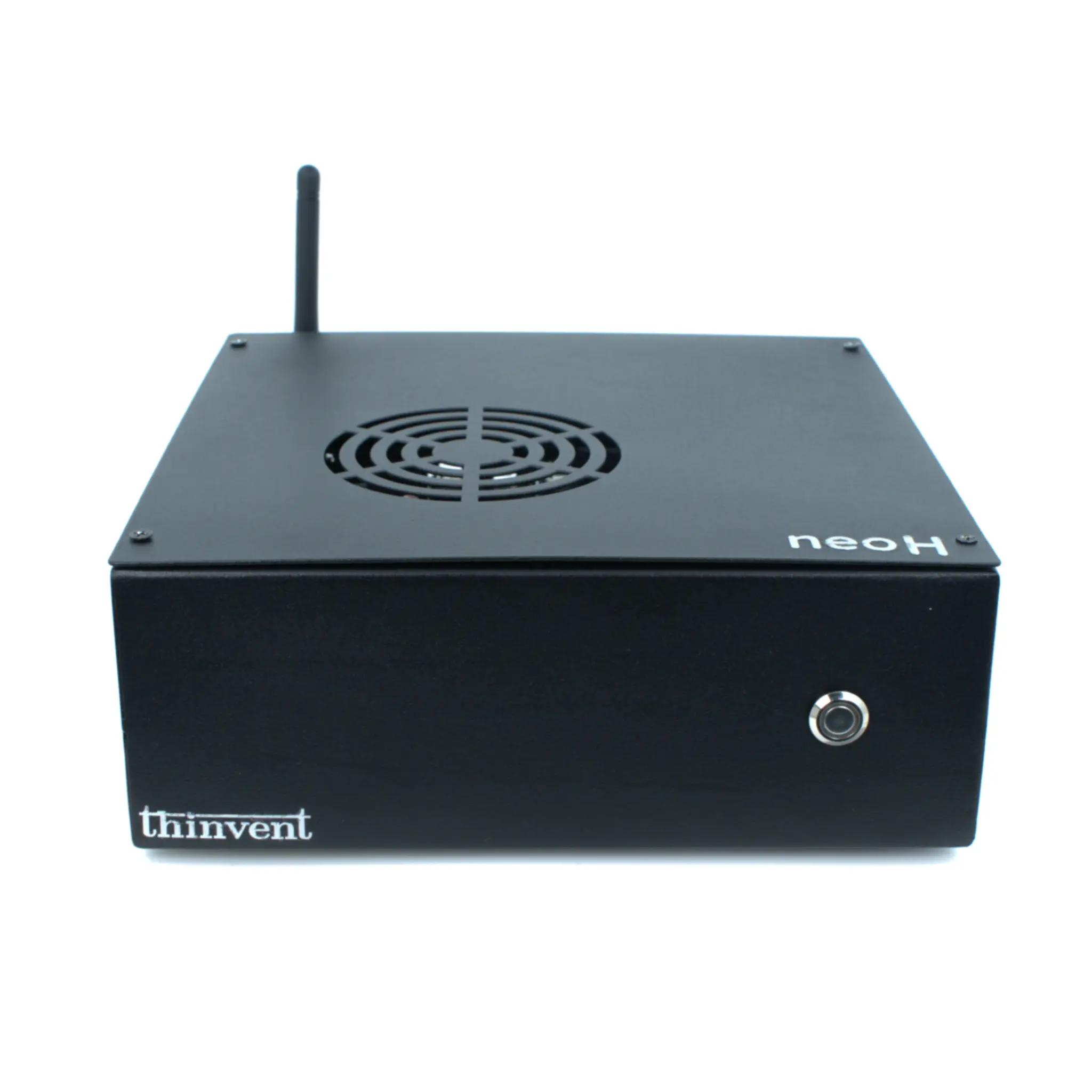
Thinvent offers a range of industrial computing platforms that serve as reliable server alternatives for demanding environments. Our Industrial PC series (IPC1, IPC3, IPC5) features Intel processors from N100 to Core i5-1240P, with 8-16GB RAM, 256-512GB SSD storage, and robust 12V DC power supplies. These systems are designed for 24/7 operation, with fanless chassis options and wide temperature tolerance, making them ideal for edge server deployments, factory automation, and IoT gateways. For lighter workloads, our Aero and Treo Mini PCs provide compact, energy-efficient computing with Intel N100 or Core i3 processors, suitable for distributed edge computing nodes. All Thinvent industrial systems support Windows 11 IoT, Ubuntu Linux, or Thinux Embedded Linux, ensuring compatibility with your existing infrastructure.