Understanding Stepper Motor Control Systems
A stepper motor manufacturer's product line — whether they build NEMA 17, NEMA 23 or NEMA 34 motors — ultimately depends on a control layer that translates motion commands into precise electrical pulses. That control layer is typically a computer: an industrial PC, a mini PC or an embedded controller running motion control software. Stepper motors move in discrete steps, and each step corresponds to a pulse sent by a driver, which in turn receives direction and pulse signals from a host controller. The accuracy, timing consistency and reliability of that host controller directly determine whether the motor runs smoothly or loses steps.
How Stepper Motors Are Driven and Controlled
A typical stepper motor system has four layers. First, the motor itself, rated by step angle (commonly 1.8° per step, or 200 steps per revolution) and holding torque. Second, a driver — often a microstepping driver such as the A4988, DRV8825, TB6600 or a DM-series unit — that amplifies low-power logic signals into the coil currents the motor needs. Third, a pulse generator or controller board (Arduino, PLC, or dedicated motion controller) that issues step and direction signals. Fourth, a host computer that runs the motion profile, CAM/G-code interpretation, or SCADA/HMI layer.
In industrial settings, the host computer is frequently a fanless industrial PC with multiple serial ports, USB, Ethernet and sometimes GPIO, because stepper motor applications often run 24/7 in dusty, hot or vibration-heavy environments. Common software includes LinuxCNC, Mach3/Mach4, GRBL-based toolchains, TwinCAT, CODESYS, and custom Python or C++ motion stacks.
Typical Applications
Stepper motors are used in CNC routers, 3D printers, laser cutters, pick-and-place machines, labelling equipment, textile machinery, packaging lines, camera sliders, laboratory dosing pumps, and CNC retrofits. In each case, the controlling computer must deliver deterministic timing, support the right I/O (parallel port, USB, Ethernet, or dedicated motion card), and survive the shop floor.
| Requirement | Typical Specification |
|---|---|
| Step resolution | 200 steps/rev (1.8°), microstepped to 1/16 or 1/32 |
| Control interface | USB, Ethernet, RS-232/RS-485, DB9 serial, GPIO |
| Host OS | Linux (LinuxCNC), Windows, real-time kernels |
| Environment | Dust, heat, vibration, 24/7 duty cycles |
| Form factor | Fanless industrial PC or DIN-rail mini PC |
Choosing a Host Computer for Motion Control
When selecting a computer to sit alongside stepper motors, look for fanless cooling (no dust ingress), wide DC input tolerance, multiple serial ports for driver communication, and enough CPU headroom to run real-time motion loops without jitter. Intel Core i3 and Celeron-class processors are common choices — they offer strong single-thread performance (important for pulse timing) at modest power. Multiple DB9 serial ports are valuable when a single PC coordinates several drivers or axes. Windows 11 Pro, Windows 11 IoT, Linux and DOS are all valid host operating systems depending on the motion stack.
Thinvent Industrial PCs for Stepper Motor and Motion Control
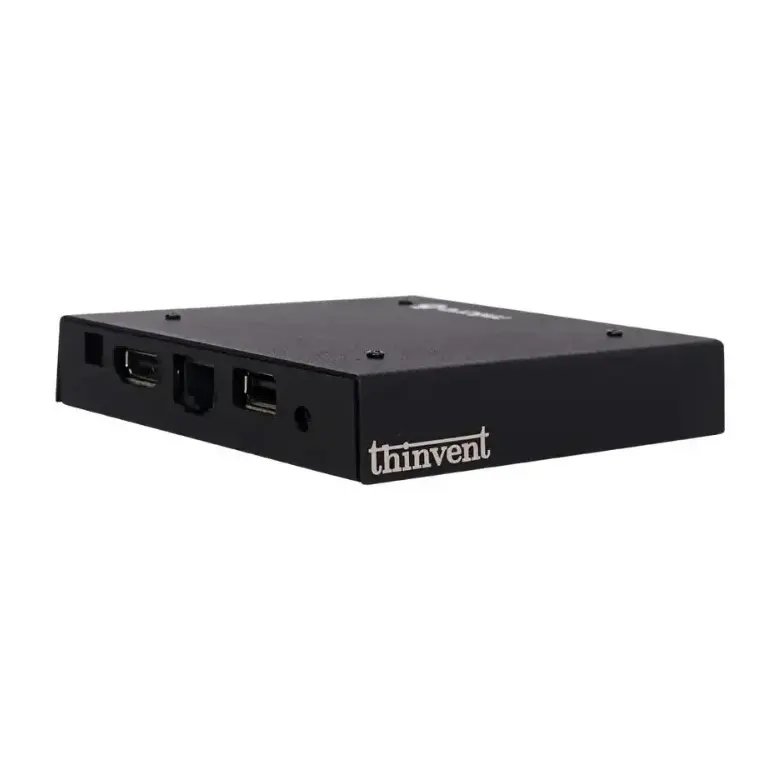
Thinvent builds fanless industrial computers designed for exactly this class of application. The IPC3 series, for example, pairs an Intel Core i3-1215U (6 cores, up to 4.4 GHz, 10 MB cache) with 16 GB DDR4 RAM and up to 1 TB SSD, and is available with quad DB9 serial ports — useful for connecting multiple stepper drivers, PLCs or legacy motion controllers over RS-232/RS-485. Thinvent systems ship with a choice of Windows 11 Pro, Windows 11 IoT Value, DOS or Thinux Embedded Linux, so integrators can match the OS to their motion control software. Fanless construction keeps dust out and reliability high in workshop and factory environments, making Thinvent industrial PCs a practical host platform for stepper motor manufacturers, CNC builders and automation integrators.