What Makes a Warehouse PC Different?
Warehouse environments demand computers that can withstand dust, temperature fluctuations, and continuous operation. Unlike office desktops, a warehouse PC must be compact, energy-efficient, and often fanless to prevent dust ingress and ensure silent, maintenance-free operation. These systems typically power inventory management software, barcode scanners, and warehouse management systems (WMS), requiring stable wired networking and reliable storage.
Key Specifications for Warehouse Computers
A good warehouse PC should feature a low-power, fanless processor to eliminate moving parts. Intel’s N100 processor (4 cores, up to 3.4 GHz, 6 MB cache) is ideal—it delivers enough performance for WMS and data entry while consuming minimal power. At least 16 GB of RAM ensures smooth multitasking with multiple applications, and a 128 GB or larger SSD provides fast boot times and durable storage. Gigabit Ethernet is essential for wired connectivity, and multiple USB ports (e.g., USB 3.2 Gen 2) allow connection of scanners, printers, and other peripherals.
Typical Use Cases in Warehousing
Warehouse PCs are commonly deployed as:
-
Workstation terminals for inventory tracking and order picking.
-
Dedicated WMS interfaces running Windows or Linux.
-
Digital signage controllers for display panels showing real-time stock levels.
-
Data collection stations attached to barcode or RFID readers.
Their compact size (often a mini PC) allows mounting behind monitors or on shelves, saving valuable workspace.
Thinvent® Aero Mini PC – Purpose-Built for Warehouses
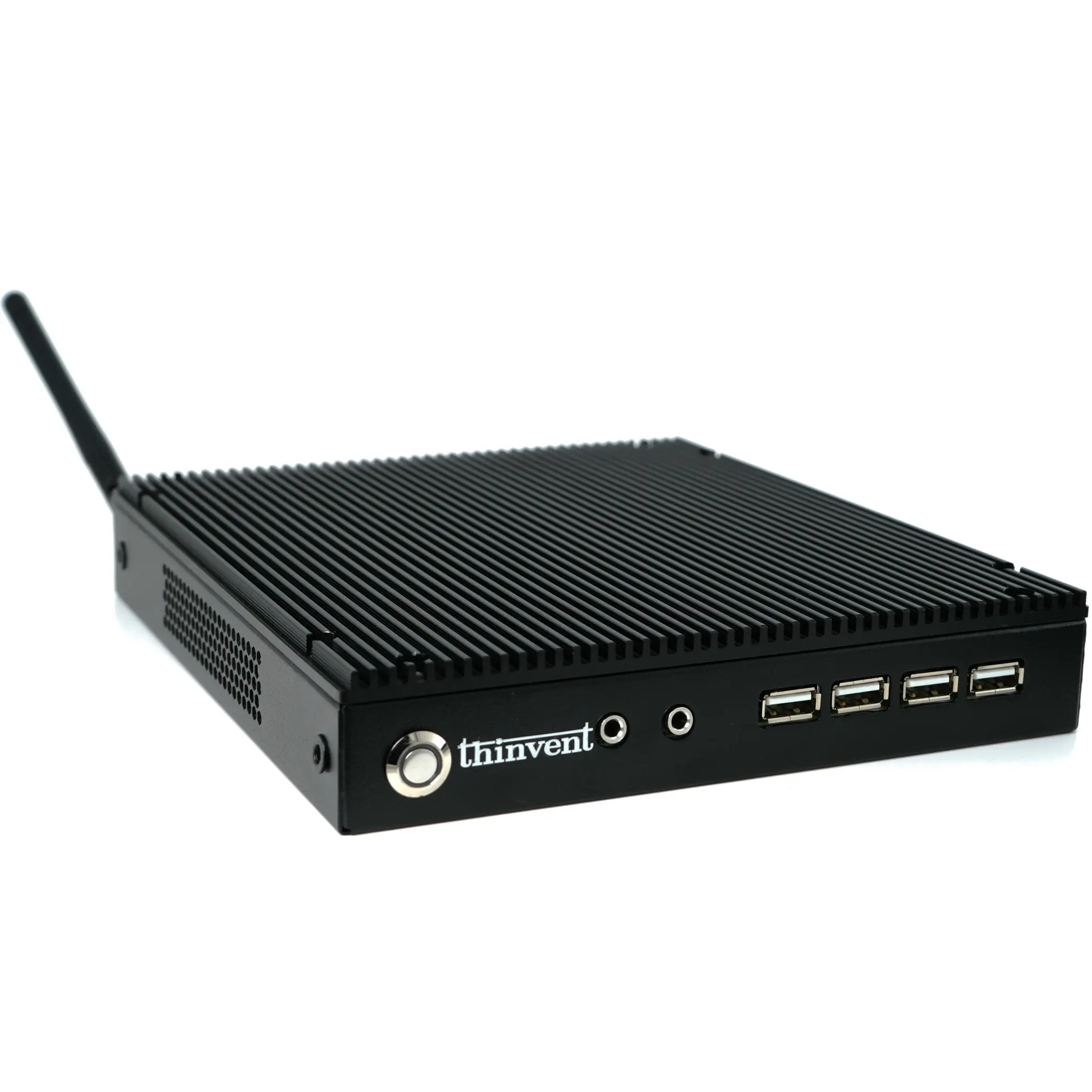
Thinvent’s Aero Mini PC series, featuring the Intel N100 processor, matches warehouse requirements perfectly. It offers a fanless design, 16 GB DDR4 RAM, a 128 GB SSD, and runs on Windows 11 Pro, Ubuntu Linux, or Thinux Embedded Linux. With no WiFi (reducing interference) and a 12V power supply, it is rugged yet energy-efficient. Available with optional keyboard and mouse sets