What is a Zero Client OS?
A Zero Client OS is a minimal, lightweight operating system designed for devices that function as endpoints in a centralized computing environment. Unlike traditional PCs, a zero client has no local operating system, storage, or applications. It boots a small, secure firmware or a stripped-down OS that connects directly to a remote server, virtual desktop infrastructure (VDI), or cloud-hosted workspace. The primary function is to establish a network connection and display the remote session, with all processing and data storage occurring on the server.
Key Specifications and Technical Details
Zero Client OS platforms are characterized by their extreme efficiency and security. They typically require minimal hardware resources: a low-power processor (like Intel Celeron or N-series), small amounts of RAM (4GB-8GB is often sufficient), and little to no local storage. The OS itself is often a custom, embedded Linux distribution or a specialized firmware. Key technical features include:
-
Ultra-Thin Footprint: The OS image is tiny, often under 1GB, allowing for fast boot times.
-
Enhanced Security: With no local storage or user-installable applications, the attack surface is drastically reduced. They are immune to most malware.
-
Centralized Management: All software updates, security patches, and application deployments are handled on the central server, simplifying IT administration.
-
Protocol Support: They include built-in support for display protocols like PCoIP, Blast Extreme, or HDX to ensure a smooth remote user experience.
Use Cases and Applications
Zero Client OS is ideal for environments demanding high security, easy management, and reliable performance across many identical endpoints.
-
VDI & Cloud Computing: The classic use case, providing secure access to virtual desktops in corporate, government, and healthcare settings.
-
Call Centers & Task Workers: Deploying hundreds of identical stations for data entry, customer service, or kiosk applications.
-
Education: In computer labs, where students access standardized software suites from a central server, preventing local configuration changes.
-
Industrial & Manufacturing: On the factory floor for HMIs (Human-Machine Interfaces) where reliability and uptime are critical, and the environment may be harsh.
Operating System Comparison for Client Devices
| Feature | Zero Client OS (Embedded) | Traditional Desktop OS (e.g., Windows 11) | Thin Client OS (e.g., Thinux) |
|---|---|---|---|
| Local Processing | Minimal to none; only for connection | Full local processing | Light local processing for some apps |
| Local Storage | None or very limited (for OS only) | Significant (for OS, apps, data) | Limited (for OS and cache) |
| Security | Very High (stateless, immutable) | Moderate (requires active management) | High (locked down, managed) |
| Management | Centralized (server-side only) | Individual or group policy | Centralized & remote management |
| Total Cost of Ownership | Lower (less hardware, easier IT) | Higher (more hardware, complex IT) | Moderate |
Thinvent Products Featuring Zero Client Capabilities
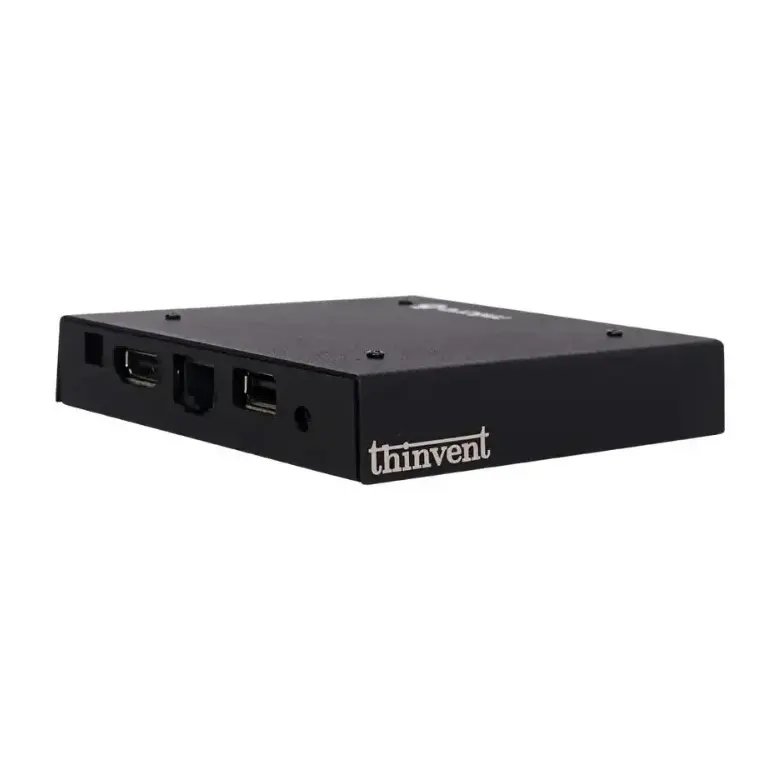
Thinvent's industrial computing solutions are perfectly suited for zero client deployments. Our fanless Mini PCs and Thin Clients, such as the Aero series, offer the reliable, low-power hardware foundation required. They can be configured with a "Without OS" option or pre-loaded with a lightweight, secure operating system like our custom Thinux™ Embedded Linux or Ubuntu Linux, providing an ideal platform for IT administrators to deploy their preferred zero client firmware or connection broker. This flexibility allows organizations to build a robust, secure, and easily managed endpoint infrastructure using Thinvent's durable and compact hardware.