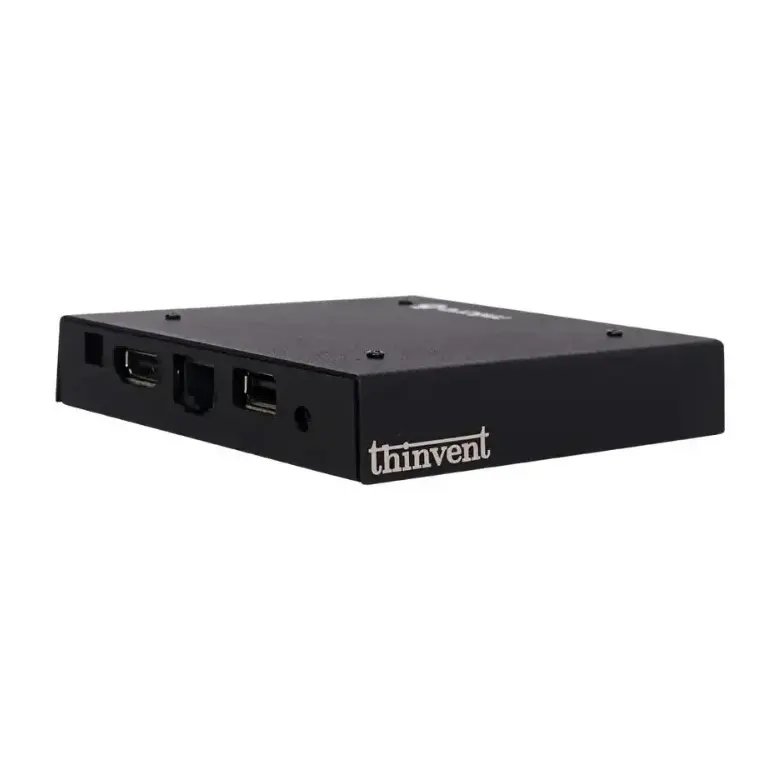
What Makes an Industrial PC Different?
An industrial PC is a computing system engineered to operate continuously in environments where ordinary desktop computers fail. Unlike office-grade machines, industrial PCs are built around wide-temperature components, fanless passive cooling, vibration-resistant mounting, and long-term supply stability. They are designed to run 24x7 in factory floors, control cabinets, kiosks, and outdoor enclosures where dust, heat, humidity, and electrical noise are constant realities.
The core difference lies in thermal design. A conventional PC relies on fans to move air across the CPU heatsink, but fans draw in dust and eventually seize. A fanless industrial PC instead uses the chassis itself as a heatsink, conducting heat away from the processor through aluminium fins or a machined block. This removes the single most common point of failure in a deployed computer and allows operation across a wide ambient temperature range.
Key Specifications to Evaluate
When selecting an industrial computer, the specifications that matter most are processor class, memory and storage, I/O count, and power input. Modern Intel® Core™ processors such as the i3-1215U deliver 6 cores, up to 4.4 GHz burst frequency, and 10 MB cache — enough for HMI software, SCADA clients, vision pre-processing, and multi-window operator stations. DDR4 memory from 8 GB to 32 GB supports virtualisation and database workloads, while SSD storage from 128 GB to 1 TB handles logging and local data retention.
| Specification | Typical Industrial Requirement | Why It Matters |
|---|---|---|
| Cooling | Fanless, passive | Dust immunity, no moving parts |
| Processor | Intel® Celeron®, N-series, Core™ i3/i5 | Balance of performance and power draw |
| Memory | 8–32 GB DDR4 | Multi-application stability |
| Storage | 128 GB–1 TB SSD | Shock resistance, fast boot |
| Serial Ports | DB9 RS-232/RS-485 | PLC, meter, legacy device links |
| Ethernet | Dual Gigabit | Network segregation, redundancy |
| Power | 12V DC or wide-range DC | Vehicle and DIN-rail supplies |
| Mounting | VESA, DIN-rail, wall bracket | Flexible installation |
Where Industrial PCs Are Deployed
Industrial PCs appear wherever a standard computer would be unreliable. On manufacturing lines they run machine vision, motion control front-ends, and production dashboards. In utilities and energy they act as substation gateways, protocol converters, and data concentrators. In retail and logistics they drive digital signage, weighbridge terminals, and warehouse scanning stations. Transportation applications include vehicle-mounted terminals, fleet telematics, and ticketing systems that must survive vibration and ignition transients.
Serial connectivity remains a defining requirement. Many industrial devices — PLCs, energy meters, barcode scanners, CNC controllers — still communicate over RS-232 or RS-485. Industrial PCs with multiple DB9 ports allow a single machine to interface with several field devices without external converters, reducing wiring complexity and failure points.
Operating System and Software Considerations
Industrial deployments favour operating systems with long support lifecycles. Microsoft Windows 11 Pro and Windows 11 IoT Value provide a familiar application platform with extended servicing, while Ubuntu Linux 24.04 LTS and embedded Linux distributions offer stability, lower licensing overhead, and fine-grained control over the runtime environment. Some integrators prefer DOS or FreeDOS for legacy control software, and Thinvent supports this through its Thinux™ Embedded Linux and DOS options. Choosing the right OS at the procurement stage avoids driver surprises after commissioning.
Thinvent's Industrial PC Range
Thinvent manufactures fanless industrial PCs, mini PCs, thin clients, and all-in-one computers engineered for continuous duty. The IPC3 series pairs Intel® Core™ i3-1215U performance with 16 GB DDR4, 1 TB SSD storage, and 12V DC input, and is available with quad DB9 serial ports for multi-device field connectivity. Operating system options span Windows 11 Professional, Windows 11 IoT Value, DOS, and Thinux™ Embedded Linux, so the same hardware platform can be standardised across an entire plant regardless of software stack. For lighter workloads, Thinvent's Intel® Celeron® and N-series mini PCs offer the same fanless reliability at lower power budgets.